

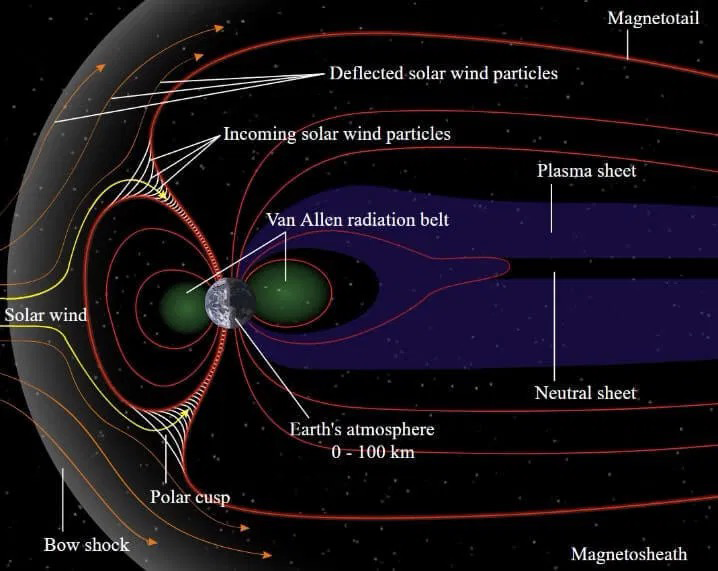
The Magnetosphere is the region around Earth dominated by its magnetic field, which acts as a protective shield against space weather phenomena like solar wind and cosmic rays.
- It starts above the ionosphere (~60 km) and extends tens of thousands of kilometers into space.
- The source of magnetic Field generated by electric currents in Earth’s liquid outer core (mostly molten iron and nickel).
- Its shape is compressed on the day side (facing the Sun) and elongated on the night side.
Functions:
- Deflects Solar Wind: The fast-moving plasma from the Sun is deflected around Earth.
- Prevents Atmospheric Loss: Without it, solar wind could strip away the upper atmosphere, including:
- The ozone layer, crucial for blocking harmful UV radiation.
- Traps Particles: Creates radiation belts (Van Allen belts) that trap charged particles and protect the surface.
- A Van Allen radiation belt is a zone of energetic charged particles, most of which originate from the solar wind, that are captured by and held around a planet by that planet’s magnetic field.
- There are two such concentric tire-shaped regions. The inner belt is 1–2 Earth radii out while the outer belt is at 4–7 Earth radii.
- By trapping the solar wind, the belts deflect the energetic particles and protect the atmosphere.
Sun’s Magnetosphere – The Heliosphere
- The heliosphere is a vast bubble-like region of space dominated by the solar magnetic field and the solar wind, essentially forming the Sun’s magnetosphere.
- It extends beyond Pluto.
- Act as a shields the Solar System; Deflects or slows down a significant portion of galactic cosmic rays (GCRs)—high-energy particles from outside the Solar System and helps regulate the cosmic ray intensity reaching planets.
Why do auroras occur?
- Auroras begin with activity on the surface of the Sun. The Sun constantly emits a stream of charged particles (mainly electrons and protons) and magnetic fields, collectively known as the solar wind.
- As the solar wind approaches Earth, it encounters the magnetosphere — Earth’s magnetic field in space. The magnetosphere deflects most of the solar wind, acting like a protective shield.
- Some charged particles from the solar wind become trapped by the magnetic field.These particles are channeled along magnetic field lines toward the North and South Poles.
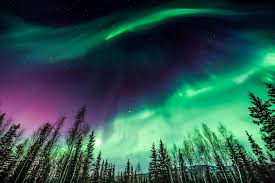
- The charged particles enter the upper atmosphere and collide with gas molecules, including: Oxygen and Nitrogen. These collisions transfer energy to the gas molecules, which then release this energy as light, creating the aurora.
- The type of gas and the altitude of the interaction determine the color of the aurora:
- Oxygen → Green (most common), sometimes red.
- Nitrogen → Blue and purple/violet shades.
- The type of gas and the altitude of the interaction determine the color of the aurora:
- Under normal conditions, auroras are mostly visible near the polar regions. However, during intense solar activity, auroras can be seen at lower latitudes (e.g., parts of Europe, the U.S., or India).