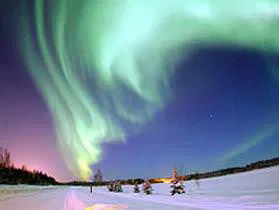
Geomagnetic storms are powerful disturbances in Earth’s magnetic field, triggered by heightened solar activity. These storms are a key feature of space weather, a term that describes the ever-changing conditions in our planet’s magnetic environment.
- The solar wind—a stream of charged particles from the Sun—plays a central role.
- When the solar wind is weak, the Earth’s magnetosphere expands.
- When it is strong, the magnetosphere compresses, allowing more energy and particles to enter.
- Sometimes, a coronal mass ejection (CME)—a colossal eruption of plasma and magnetic fields from the Sun—blasts into space.If this solar shockwave is directed toward Earth, it can arrive in just two days, triggering a geomagnetic storm.
- At Earth’s surface, a geomagnetic storm is observed as a sudden drop in the strength of the magnetic field and high above the equator, an intense electric current called the Ring Current forms, further disturbing the magnetosphere.
Impacts of Geomagnetic Storms
- The ionosphere—a region critical for radio transmission—gets heated and distorted, disrupting long-distance radio communications.
- It also expands, increasing drag on satellites and making it harder to maintain their orbits.
- Satellite systems, especially GPS, can become unreliable.
- Astronauts and high-altitude pilots may be exposed to elevated radiation levels, posing health risks.
- Geomagnetic storms can induce surges in electrical grids, potentially leading to widespread blackouts and infrastructure damage.