Paleomagnetism is the scientific study of the record of Earth’s magnetic field preserved in rocks, sediments, and archaeological materials. Over geological time, as certain types of rocks form—especially those rich in iron—they record the direction and polarity of the Earth’s magnetic field at that moment.
- These natural records allow scientists to trace the history of the planet’s magnetism, including magnetic field reversals, in which the north and south magnetic poles switch places.
- The story begins beneath the oceans, where basaltic(rich in magnetic minerals) rocks form from cooling lava.As molten basalt rises and cools, these minerals begin to crystallize and align themselves with the Earth’s magnetic field, just like tiny compass needles. Once the rock solidifies, the alignment is fixed—locking in a snapshot of Earth’s magnetic orientation at that moment in time. This natural recording is known as a thermoremanent magnetization.
- In the mid-20th century, scientists studying seafloor rocks near mid-ocean ridges, like the Mid-Atlantic Ridge, found parallel bands with alternating magnetic polarity on both sides. This magnetic striping showed Earth’s magnetic field had reversed multiple times and confirmed that new crust forms at ridges and spreads outward, proving seafloor spreading.
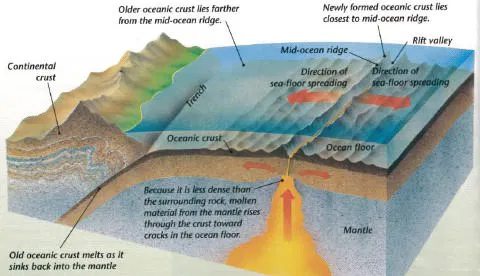
The Process of Magnetic Striping:
- Mid-ocean ridges are boundaries where tectonic plates are moving apart.
- Magma rises through the fissure or vent between the diverging plates.
- As the magma cools and solidifies, magnetic minerals within it align with the current direction of Earth’s magnetic field.
- Over time, the convection currents in the mantle cause the tectonic plates to drift apart, carrying the solidified rock with them.
- A few million years later, if the Earth’s magnetic field reverses, newly rising magma records the opposite polarity.
- This cycle repeats over geological time, creating alternating stripes of normal and reversed polarity on the seafloor.
- These alternating magnetic stripes serve as a timeline of Earth’s magnetic field and a direct record of the process of seafloor spreading.
From Paleomagnetism to Plate Tectonics
- Paleomagnetism helped revive Alfred Wegener’s theory of continental drift by providing a mechanism: seafloor spreading.
- Magnetic striping on the ocean floor confirmed that new crust forms at mid-ocean ridges and pushes outward, causing continents to move.
- This discovery led to the modern theory of plate tectonics, transforming our view of Earth’s dynamic surface.
Do You Know Why Paleomagnetism is called as Geological GPS
- Reconstruct the past positions of continents.
- Track the movement of tectonic plates through time.
- Understand the timing and frequency of magnetic field reversals.
- Analyze the rate of seafloor spreading.