

Crime and Criminal Tracking Network and Systems (CCTNS)
Basic Facts
- Launched in 2009 under the Ministry of Home Affairs
- Budget: ₹2,000 crore
- Part of India’s National e-Governance Plan
- Classified as a Mission Mode Project (MMP)
Objective
- Establish a comprehensive and integrated system to enhance the efficiency and transparency of police operations at the police station level.
- Provides tools for investigation, data analytics, policymaking, and citizen-centric services.
Key Features
- Connects all 17,130 police stations across 28 states and 8 UTs.
- Achieved 100% deployment, thus including remote areas like Manipur, Nagaland, and Lakshadweep
- Maintains a comprehensive crime database, i.e. records of accused persons, habitual offenders, proclaimed offenders, missing persons, and stolen vehicles.
- Enables citizens to track complaints, verification requests, and case updates.
- Integrated with the Integrated Criminal Justice System (ICJS), connecting police data with courts, prisons, prosecution, forensics, and fingerprint databases.
- Key Updates Under New Laws
- Bharatiya Nyaya Sanhita, Bharatiya Sakshya Adhiniyam, Bharatiya Nagarik Suraksha Sanhita
- Mandatory videography of crime scenes and forensic evidence collection in cases punishable by over seven years
- Biological samples collected upon request of investigating officers
- Senior officer approval required for arrests in specific cases
- Arrest information communicated to relatives and displayed publicly
- Victims updated on investigation progress within 90 days
- Daily diaries sent to magistrates fortnightly
National Crime Records Bureau (NCRB)
- Established in 1986 under the Ministry of Home Affairs
- Headquarters: New Delhi
- Acts as the central repository for crime and criminal data in India
- Key Responsibilities
- Collecting and analysing crime statistics
- Managing the Central Finger Print Bureau thus maintains a national database of fingerprints
- Publishing key reports:
- Crime in India
- Accidental Deaths & Suicides
- Prison Statistics
- Providing technical support in Digital Forensics and Network Security
Members of Parliament Local Area Development Scheme (MPLADS)
Basic Facts
- Type: Central Sector Scheme
- Launched: 1993
- Nodal Ministry: Ministry of Statistics and Programme Implementation
- Fund Allocation: Each MP is entitled to ₹5 crore per annum
- Funds are non-lapsable — unspent amounts are carried forward to subsequent years
- Objective
- Enable Members of Parliament to recommend works for creation of durable community assets such as drinking water, sanitation, etc., based on locally felt needs
- Implementing Agency
- Government departments, trusts, and cooperatives selected by the Implementing District Authority (IDA)
- Jurisdiction of MPs
- Lok Sabha MPs: Can recommend works within their Lok Sabha constituency
- Rajya Sabha MPs: Can recommend works within the state they are elected from
- Nominated Members: Can recommend works anywhere in the country
Special Provisions
- SC/ST Areas
- MPs must recommend at least 15% of MPLADS funds for SC-inhabited areas and 7.5% for ST-inhabited areas every year
- If a Lok Sabha constituency has fewer tribals, funds may be utilised in SC-dominated areas and vice versa
- Out-of-Area Exceptions
- MPs can recommend up to ₹50 lakh per year outside their usual region (raised from ₹25 lakh after April 2023)
- In case of a calamity of severe nature (as declared by the Government of India), MPs can recommend up to ₹1 crore for the affected district
Goods and Services Tax (GST)
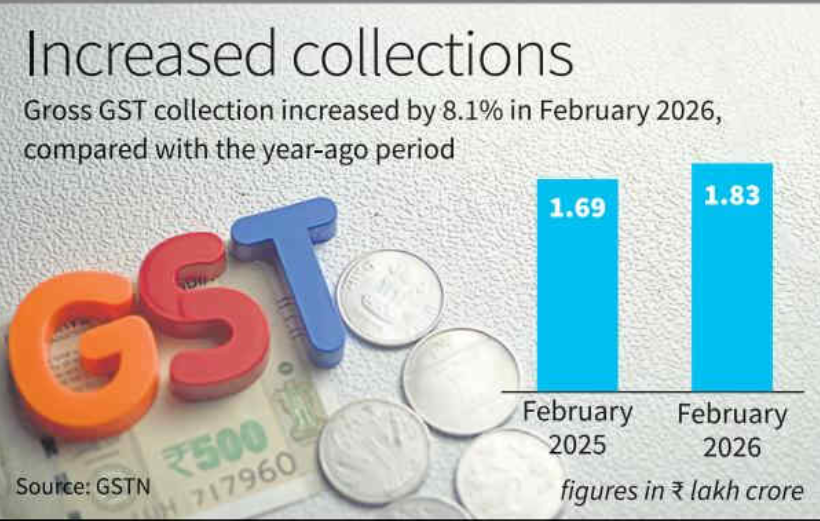
Context: Gross GST collection increased by 8.1% to over ₹1.83 lakh crore in February, led by higher growth in revenues from imports and domestic sales. Gross domestic revenue rose 5.3% to about ₹1.36 lakh crore, while gross import revenue climbed 17.2% to ₹47,837 crore.
What is GST?
- GST is an indirect tax levied on the supply of goods and services for domestic consumption across India
- It is based on the principle of value addition at each stage of the supply chain
- GST has unified and replaced a range of previous indirect taxes levied by both Central and State Governments
- Consumers pay this tax at the point of purchase, while businesses collect and deposit it with the government
Constitutional Framework
- GST was introduced in Parliament in 2014 and passed as the Constitutional 101st Amendment Act, 2016.
- Three new articles were introduced
- Article 246A: Parliament and State Legislatures get concurrent powers to legislate on GST; Parliament alone legislates on inter-state trade.
- Article 269A: Inter-state GST collected by Central Government and distributed between Centre and States as per GST Council recommendations
- Article 279A: President of India has the power to outline the composition and functioning of the GST Council
Key Features
- Tax on Supply levied on supply, not on manufacture or sale (unlike earlier regime)
- Destination-Based Tax revenue goes to the state where goods/services are consumed, not produced
- Dual GST Structure, both the Centre and States levy GST simultaneously on a common base
- Harmonised Tax Rates finalised through mutual agreement between Centre and States based on GST Council recommendations
- Multiple Tax Slabs currently 7 slabs for goods and 5 slabs for services
- Threshold Exemption small businesses with turnover below specified limits are exempt from GST
Four Components of GST
- CGST (Central GST):
- Levied on intra-state transactions
- Collected by the Central Government
- Rate is uniform across India
- SGST (State GST):
- Levied on intra-state transactions alongside CGST
- Collected by the respective State Government
- States have the power to decide their own rates
- UTGST (Union Territory GST):
- Applicable in UTs with their own legislature
- Collected alongside CGST
- Each UT has the authority to decide its own GST rates
- IGST (Integrated GST):
- Levied on inter-state supply of goods and services
- Collected by the Central Government and then distributed between Centre and States
- Rate remains uniform across the country
GST Council
- Established under Article 279A by the President of India
- Recommends key aspects of GST — tax rates, exemptions, laws, and procedural rules
- Plays a central role in overseeing the implementation and administration of the GST framework
Arbitrage
What is Arbitrage?
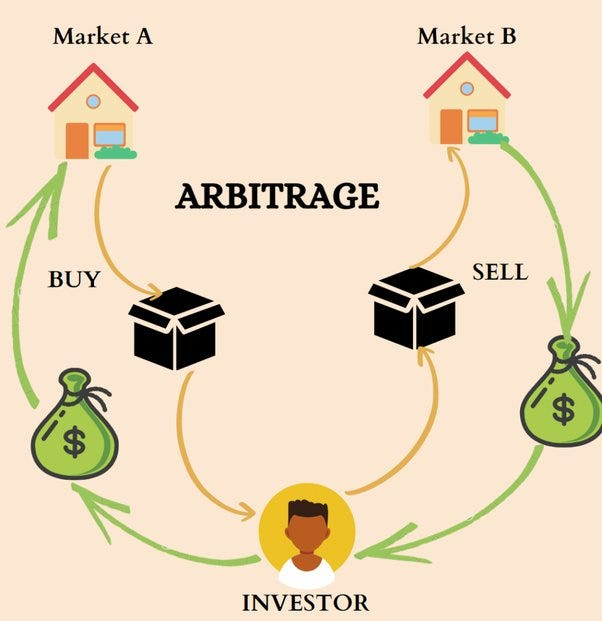
- Arbitrage refers to the practice of capturing profit from price gaps of the same asset in two different markets or financial instruments
- Involves buying at a lower price and selling at a higher price at nearly the same time
- Since trades are executed simultaneously, it does not rely on market predictions
Arbitrage Funds
- A category of hybrid mutual funds that generate returns from short-lived price differences
- Classified by SEBI as equity-oriented funds
- Must maintain at least 65% gross exposure to equities or equity-related securities
- Remaining/unutilised portions are invested in short-term debt or money-market instruments for liquidity management
How Do Arbitrage Fund Managers Operate?
- Buy a stock in the cash (spot) market at a lower price and sell its futures contract in the derivatives market at a higher price
- Alternatively, exploit price differences across exchanges, i.e. buying on NSE and selling on BSE (or vice versa)
- Do not attempt to predict market direction (bullish or bearish)
Role of Market Volatility
- Higher volatility increases the likelihood of price mismatches across exchanges or between spot and derivatives markets, creating more arbitrage opportunities
- In calm or sideways markets, price gaps may be smaller or disappear quickly, limiting opportunities
Risks & Returns
- Not entirely risk-free as returns depend on availability of pricing gaps, which can vary
- Short-term fluctuations may occur due to execution risks, limited liquidity, or transaction costs
- Historically delivers about 6–7% annualised returns, considered a moderate, low-volatility return option.
- Not suitable for investors seeking aggressive long-term or high equity-style growth
Coconut Development Board
Basic Facts
- A statutory body under the Ministry of Agriculture and Farmers Welfare, Government of India
- Established on 12th January 1981
- Headquarters: Kochi, Kerala
- Regional Offices: Bangalore (Karnataka), Chennai (Tamil Nadu), Guwahati (Assam), and Patna (Bihar)
Objective
- Integrated development of coconut production and utilisation in India
- Focus on productivity increase and product diversification
Key Functions
- Imparts technical advice to those engaged in coconut cultivation and industry.
- Provides financial and other assistance for expansion of area under coconut.
- Encourages adoption of modern technologies for processing coconut and its products.
- Recommends measures for improving marketing of coconut and its products.
- Recommends measures for regulating imports and exports of coconut and its products.
- Fixes grades, specifications, and standards for coconut and its products.
- Adopts measures to secure incentive prices for coconut and its products.
Iran
Basic Facts
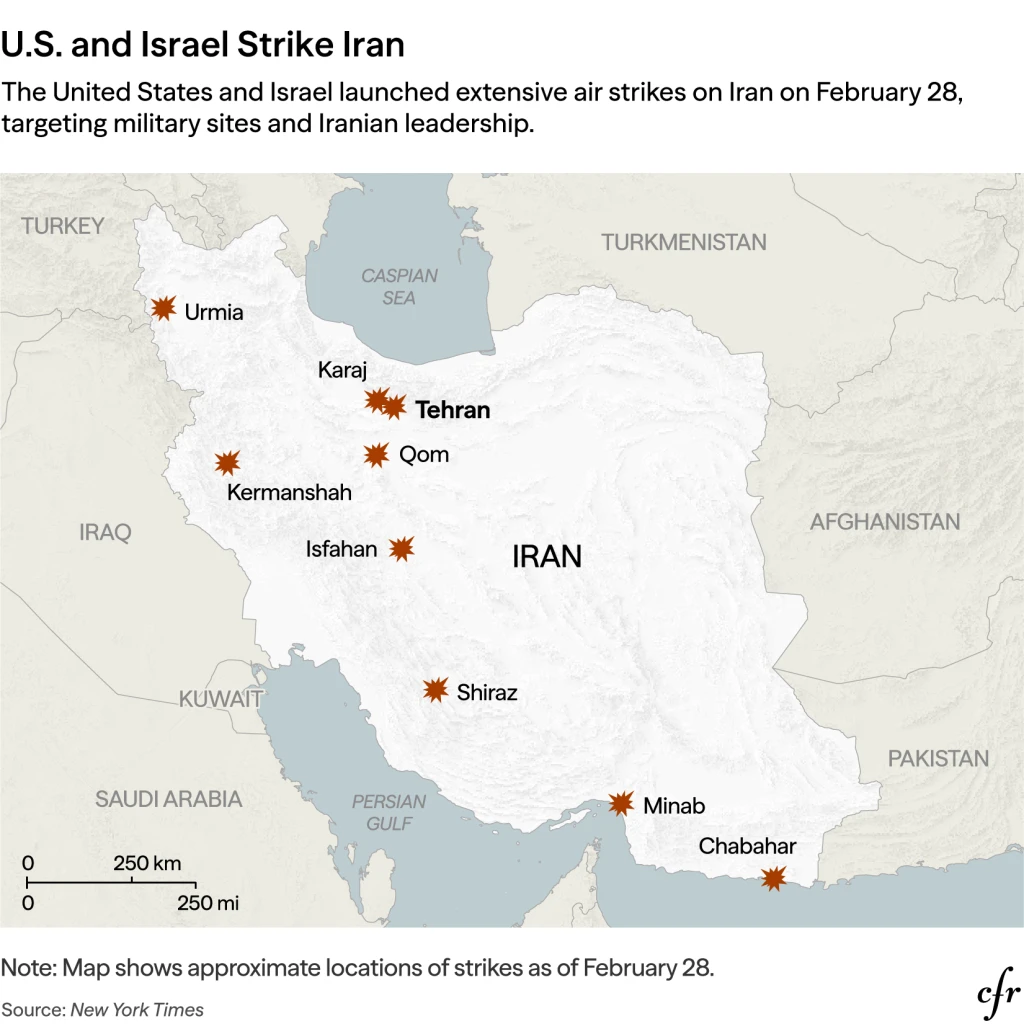
- Located in southwestern Asia (West Asia) thus acts as a bridge between the Middle East, Central Asia, and South Asia
- Commands strategic access to the Persian Gulf and the Strait of Hormuz
- Capital: Tehran
- Political System: Combines republican institutions with a Shia Islamic theocracy — since the 1979 Islamic Revolution, real power rests with the Supreme Leader
- Neighbouring Nations: Azerbaijan, Armenia, Turkmenistan, Afghanistan, Pakistan, Turkey, Iraq
- Bordered by: Caspian Sea, Persian Gulf, and Gulf of Oman
Key Physical Features
- Central Iranian Plateau:
- Vast, arid, and elevated region forming Iran’s core
- Dominated by Dasht-e Kavir and Dasht-e Lut deserts
- Characterised by extreme temperatures, salt flats, and sparse habitation
- Zagros Mountains:
- Long northwest–southeast mountain system in western Iran
- Geologically young and tectonically active
- Rich in hydrocarbons
- Forms a natural barrier between the plateau and the Mesopotamian plains
- Alborz Mountains:
- Runs along the southern Caspian Sea coast
- Contains Mount Damavand: Iran’s highest peak
- Sharply separates the fertile Caspian lowlands from the interior plateau
- Seismic Activity:
- Located at the convergence of the Arabian and Eurasian tectonic plates
- One of the world’s most seismically vulnerable regions
- Rivers:
- River systems are largely seasonal due to arid conditions
- Karun River (southwest) is Iran’s only fully navigable river and a key source of irrigation and hydroelectric power
Bail and Its Types
What is Bail?
- Bail is the conditional/provisional release of a person held under legal custody in matters yet to be pronounced by the Court
- It involves a promise to appear in Court as and when required
- Signifies a security or collateral deposited before the Court for release
Types of Bail in India
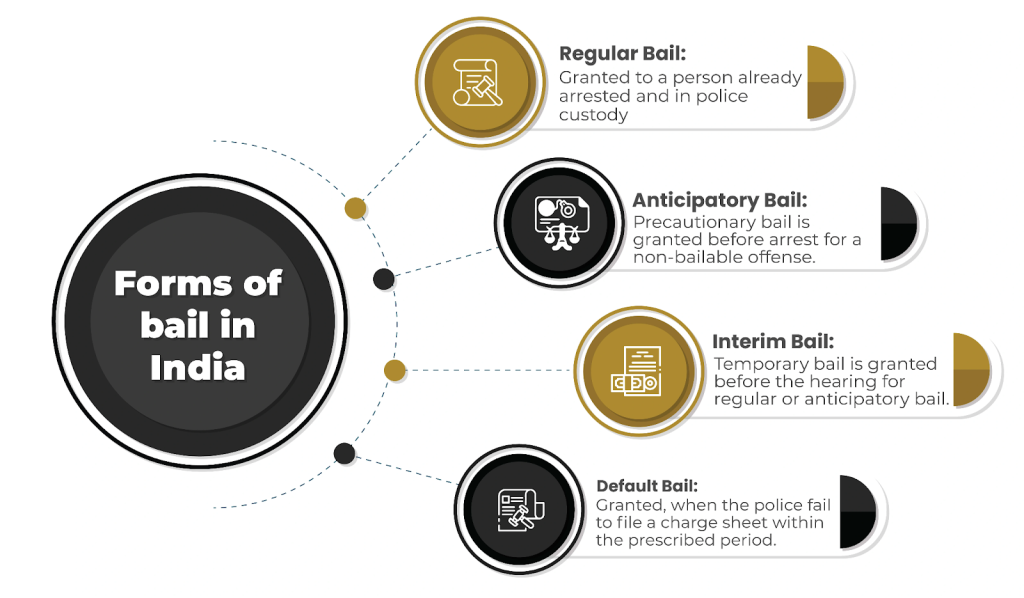
- Regular Bail
- A direction by any Court to release a person who is already under arrest and in police custody
- Application filed under Section 437 and 439 of CrPC
- Interim Bail
- Bail granted for a temporary and short period
- Granted while an application for Anticipatory Bail or Regular Bail is still pending before the Court
- Anticipatory Bail (Pre-Arrest Bail)
- Allows an accused to apply for bail before being arrested
- Granted under Section 438 of CrPC, 1973
- Issued only by Sessions Court and High Court
- Discretionary and not an absolute right
Conditions for Granting Anticipatory Bail
- The person must have reason to believe they may be arrested for a non-bailable offence
- Must make themselves available for interrogation by the investigating officer
- Court considers:
- Nature and gravity of the offence
- Antecedents of the accused
- Likelihood of absconding or tampering with evidence
- Court may impose conditions such as:
- Surrendering passport
- Not leaving the country
- Reporting to police station regularly
- May be granted for a limited period and the person must surrender to custody once it expires
- Court may also impose a monetary bond in case of non-appearance or violation of conditions
Human Papillomavirus (HPV)
About Human Papillomavirus (HPV)
- HPV is a group of more than 200 related viruses.
- More than 40 types spread through direct sexual contact.
- 2 types cause genital warts, while about a dozen types can cause certain cancers.
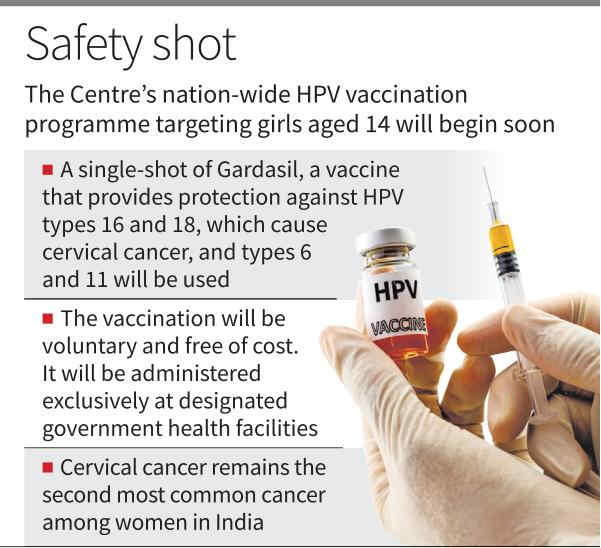
- More than 95% of cervical cancer cases are caused by HPV.
- Transmission
- HPV is the most common STI (Sexually Transmitted Infection) globally.
- Also spreads through skin-to-skin contact, not just sexual contact.
- Most infected people remain completely asymptomatic i.e. they carry and spread the virus without knowing it.
- In most cases, the body naturally clears the virus on its own.
- If the virus persists in the body for long, it can eventually lead to cancer.
- HPV Vaccine
- Administered as a series of shots.
- Prevents HPV infections from progressing to cancer or genital warts.
- Most effective when given between 9–26 years of age.
- Once a person is already infected, the vaccine becomes less effective.
- Not administered during pregnancy.
- Protects both men and women against HPV-related cancers.
