

FCRA Rules Amendment 2026: UPSC Prelims Notes
In News: Centre Tightens Foreign Contribution Norms
- The Centre notified amendments to the Foreign Contribution Regulation Act (FCRA), 2010 Rules, requiring NGOs to stick to specified activity lists within their registered category.
- NGOs must now disclose activities, geographical scope, websites, social media accounts, and publications.
- Violations attract a minimum fine of ₹1 lakh.
About: Foreign Contribution Regulation Act (FCRA), 2010
- FCRA, 2010 regulates all foreign donations received by individuals and organisations in India.
- The Ministry of Home Affairs (MHA) is the nodal regulator for FCRA.
- Earlier amendments only required NGOs to give an undertaking that foreign funds would not affect sovereignty, integrity, or communal harmony.
- The amended rules broaden the definition of “key functionary” beyond office-bearers and directors to include:
- trustees, partners, Karta of HUF, governing body members, and anyone controlling or managing the organisation.
- Associations having foreign nationals (other than persons of Indian origin) as key functionaries will ordinarily not be eligible for registration unless specifically permitted by the Centre.
Categories: Five Permitted Heads and Activity Lists
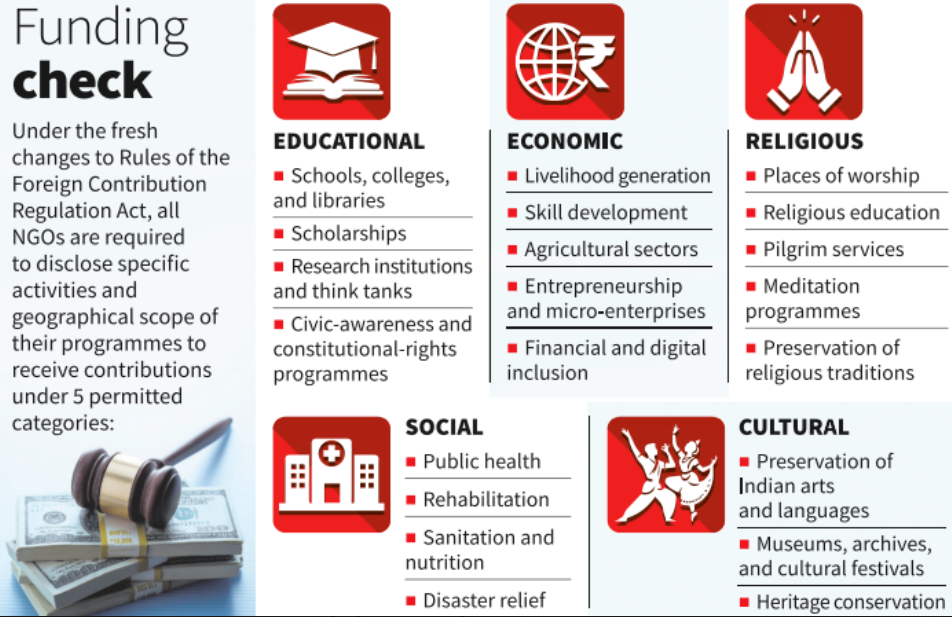
- NGOs must register under one of the five permitted categories: social, economic, educational, cultural, and religious.
- This is the first time separate activity lists have been laid out for each category.
| Category | Number of Activities |
| Social | 30 |
| Economic | 19 |
| Educational | 22 |
| Religious | 16 |
The educational category mandates that awareness programmes on constitutional rights and civic responsibilities must be strictly non-political.- The religious category excludes proselytisation and includes activities like satsangs, discourses, and cremation ground maintenance.
New Rules: Disclosure, Category-Wise Fees and Penalties
- NGOs must pay separate fees for each category and each State or UT they operate in, replacing the earlier single fee structure.
- New registrations must follow new norms; existing registrations must comply within one year.
- Using funds for unapproved purposes attracts a penalty of 30% of the amount misused or ₹1 lakh, whichever is higher.
- Using foreign funds in unapproved States or UTs also invites a fine of 30% of the amount or ₹1 lakh, whichever is higher.
- Other penalised violations include excess administrative spending, speculative investments, misuse of funds, and unauthorised receipt of foreign contributions.
Regulator: Ministry of Home Affairs
- The Ministry of Home Affairs (MHA) regulates all foreign donations under FCRA, 2010.
- The amendments aim to bring uniformity in Foreign Contribution (FC) forms and avoid duplication.
Source: The Hindu
International Maritime Organisation (IMO): UPSC Prelims Notes
Context: IMO Plans to Evacuate Ships Stuck in Persian Gulf
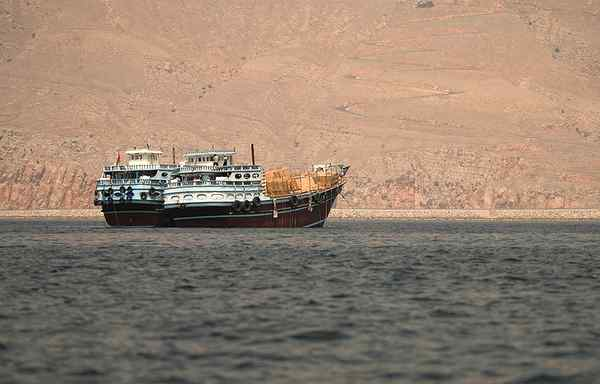
- IMO Secretary-General Arsenio Dominguez announced a plan to evacuate all ships and 11,000 seafarers stranded in the Persian Gulf due to the West Asia war.
- The operation will be carried out in cooperation with Iran, Oman, the United States, and the maritime industry.
In News: Temporary Corridors Across the Strait of Hormuz
- Oman’s Ministry of Defence wrote a letter to Pakistan’s National Hydrographic Office detailing the evacuation plan.
- Pakistan and Qatar have been mediators in negotiations between Iran and the US.
- Two routes are proposed: one along the Omani coast (south) and another along the Iranian coast (north).
- Each route can handle 20 to 30 ships per day, compared to 130 ships daily before the war.
- Automatic Identification System (AIS) must remain on during transit.
- Each shipowner and master remains responsible for conducting an independent risk assessment.
About: IMO as a UN Specialised Agency
- IMO is the United Nations’ specialised agency responsible for safety and security of shipping and prevention of marine pollution by ships.
- It is the global standard-setting authority for safety, security, and environmental performance of international shipping.
- IMO formulates regulations on shipping safety, security, and environmental protection but does not enforce them.
- Once a member state adopts a regulation, it becomes part of that country’s domestic law.
- IMO contributes directly to UN SDG 14, which focuses on conservation and sustainable use of oceans and marine resources.
Mandate: Shipping Safety, Security and Marine Pollution
- IMO’s main role is to create a regulatory framework that is fair, effective, universally adopted, and universally implemented.
- It also deals with legal matters such as liability, compensation, and facilitation of maritime traffic.
Headquarters: London (176 Member States)
- IMO is headquartered in London with 176 Member States and three Associate Members.
- Funding comes from mandatory contributions by member states, voluntary donations, and commercial revenue.
Structure: Assembly, Council and MEPC
- The Assembly is the supreme governing body, comprising all member states, meeting every two years to approve the work programme, budget, and elect Council members.
- The Council acts as the Executive Organ, overseeing IMO’s work between Assembly sessions.
- IMO has five major committees responsible for policy development and regulation formulation, including the Marine Environment Protection Committee (MEPC).
Source: The Hindu
TReDS Platform for MSMEs: UPSC Prelims Notes
In News: RBI Tweaks MSME Onboarding on TReDS
- RBI issued final directions on TReDS to simplify the system for MSMEs.
- RBI fixed a minimum net worth of ₹25 crore and statutory auditor certification for entities providing discounting services.
- Entities have been given a deadline of March 31, 2028 to comply with the net worth norm.
About: Trade Receivables Discounting System (TReDS)
- TReDS is an electronic platform facilitating financing and discounting of trade receivables of MSMEs through multiple financiers.
- These receivables can be due from corporates, government departments, and PSUs.
- TReDS enables MSMEs to auction invoices to banks and financial institutions to unlock working capital.
Purpose: Unlocking Working Capital via Invoice Discounting
- TReDS allows MSME sellers to discount invoices raised against major corporations.
- It helps MSMEs manage working capital demands and receive payments more quickly.
- The platform addresses the challenge of converting trade receivables to cash.
Participants: MSME Sellers, Buyers and Financiers
- Three categories of participants operate on TReDS: sellers, buyers, and financiers.
- Only MSMEs can participate as sellers on TReDS.
- Corporates, government departments, PSUs, and any other entity can participate as buyers.
- Banks, NBFC-Factors, and other RBI-permitted financial institutions participate as financiers.
- RBI has not made participation compulsory for buyers, sellers, or financiers.
- The government has mandated certain segments of companies to register as buyers on TReDS.
New Norm: ₹25 Crore Minimum Net Worth
- RBI has set a minimum net worth of ₹25 crore for entities providing discounting services.
- Statutory auditor certification is required alongside the net worth requirement.
- Compliance deadline is March 31, 2028.
Source: The Hindu
Kharif Crops and Monsoon Deficit: UPSC Prelims Notes
In News: 43% Rainfall Deficit to Hit Kharif Crops
- Rainfall has been 43% below normal so far this monsoon season.
- The Agriculture Ministry identified 315 districts as likely to be affected by low monsoon rainfall.
- Of these, 111 districts are “high priority” with irrigation coverage of 25% or less.
- 76 districts are “medium priority” with 25 to 50% irrigation coverage.
- 128 districts are “low priority” where relatively better irrigation is available through dams and other means.
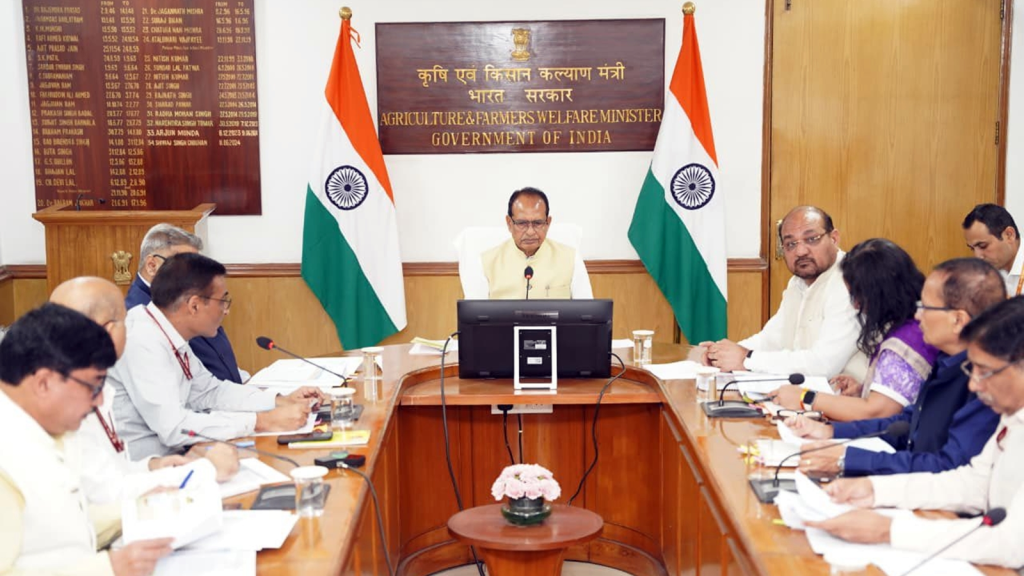
- An “El Niño Monitoring Cell” and a “Crop Weather Watch Group” have been constituted in Delhi to monitor monsoon progress and crop conditions.
- Of 36 States and UTs, as many as 26 have a rainfall deficiency of 20% or more.
- Nine states have a deficiency of more than 60%.
About: Kharif Crops and Cropping Seasons
- Kharif crops are monsoon crops sown at the beginning of the south-west monsoon (June to July) and harvested in September to October.
- The term “Kharif” is derived from Arabic, meaning “autumn.”
- India has three major cropping seasons: Kharif (monsoon), Rabi (winter), and Zaid (short summer crops).
Conditions: Climatic Requirements and Monsoon Dependence
- Kharif crops require high temperature (25°C to 35°C) and heavy rainfall (100 to 300 cm), depending on the crop.
- They are largely dependent on the south-west monsoon for water supply.
- A weak monsoon directly impacts GDP, inflation, and food security.
Major Crops: Rice, Cotton, Soybean and Producing States
- Food Crops: Rice, Maize, Jowar, Bajra.
- Cash Crops: Cotton, Jute, Sugarcane.
- Oilseeds and Pulses: Soybean, Groundnut, Arhar (Tur).
Key Producing States:
- Rice: West Bengal, Uttar Pradesh, Punjab, Andhra Pradesh.
- Cotton: Maharashtra, Gujarat, Telangana.
- Soybean: Madhya Pradesh (largest producer).
- Maize: Karnataka, Bihar.
Source: Indian Express
