

Syllabus: Effect of policies and politics of developed and developing countries on India’s interests
Context and Doctrinal Shift
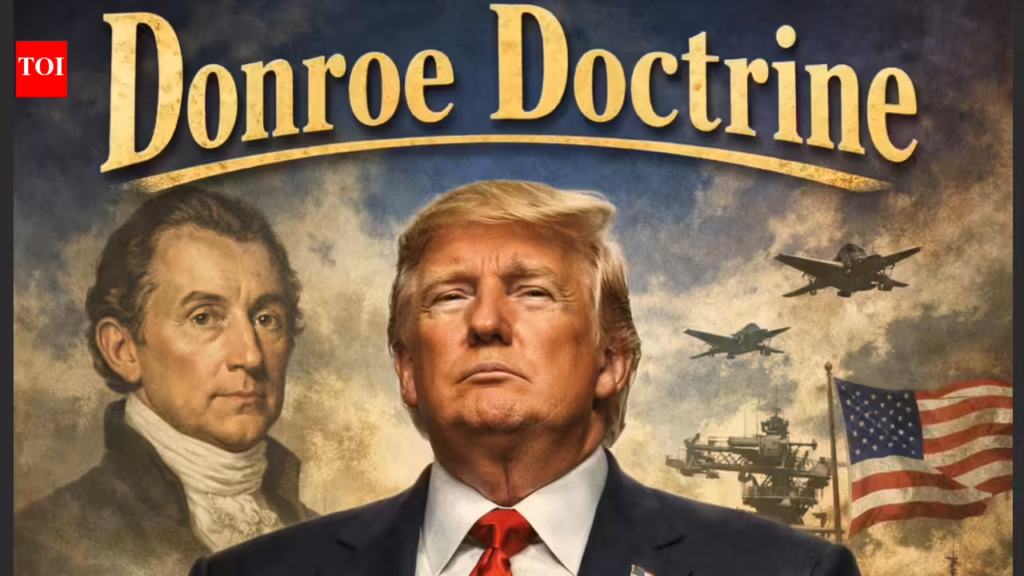
- A renewed ‘Donroe Doctrine’ is presented as a modern assertion of U.S. hemispheric dominance in global affairs.
- U.S. forces abducted Venezuelan President Nicolás Maduro and his wife, citing American security concerns.
- The action revived debates on the erosion of the post-1945 international order.
U.S. National Security Strategy and Western Hemisphere
- The November 2025 U.S. National Security Strategy (NSS) prioritises reasserting dominance in the Western Hemisphere.
- The strategy seeks to deny non-hemispheric powers military or strategic positioning.
- Implicit threats extend toward Cuba, Colombia, Mexico, and Greenland.
- The Venezuelan operation is portrayed as 21st-century ‘shock and awe’ diplomacy.
Europe, Russia, and Ukraine
- The NSS criticises Europe’s declining strategic relevance and defence preparedness.
- The U.S. urges Europe to assume primary responsibility for its own security.
- Prospects for resolving the Ukraine conflict remain uncertain and potentially unsatisfactory.
- Risks of wider European escalation persist if negotiations fail.
West Asia and Iran
- Violence in Gaza remains imminent despite the temporary end of Israeli military operations.
- Iran faces internal unrest and multi-front confrontation with the U.S. and Israel.
- Western states warn of additional sanctions targeting the Khamenei regime.
- The region risks renewed conflict aimed at undermining Iranian political authority.
South Asia and Pakistan-Afghanistan Dynamics
- Tehreek-e-Taliban activity increases instability along the Afghanistan-Pakistan border.
- Pakistan’s military influence grows, eclipsing civilian leadership and democratic processes.
- The U.S. renews strategic engagement with Pakistan, promising advanced weapon supplies.
- Bangladesh continues facing uncertainty despite commitments to restore elected governance.
China’s Strategic and Economic Position
- China withstands U.S. tariff pressures, strengthening manufacturing and supply chain influence.
- Rare earth export restrictions enhance Beijing’s geopolitical leverage.
- China’s presence expands across Southeast Asia and the Indian Ocean region.
- The Eastern Pacific is no longer viewed as an exclusive U.S. strategic domain.
Implications for India
- India faces U.S. criticism for importing subsidised Russian oil.
- Washington’s support for Pakistan complicates India’s regional security calculus.
- Positive momentum continues through I2U2 and the India–Middle East–Europe Economic Corridor.
- China’s trade advantage limits India’s ability to hedge against U.S. tariff pressures.
Security Outlook
- Terrorism remains a persistent national security threat across Asia, West Asia, and Africa.
- Instability in Iran and regional conflicts may trigger renewed insurgent and extremist activities.
