


World Trade Organization (WTO)

Basic Overview
- The World Trade Organization (WTO) is an international body regulating global trade rules among nations.
- Established under the Marrakesh Agreement (1994) after the Uruguay Round (1986–94) of GATT. It came into force in 1995, replacing GATT (1948).
- Scope expanded beyond GATT:
- GATT: Trade in goods
- WTO: Trade in goods, services, and intellectual property
- Headquarters: Geneva, Switzerland
- Members: 166 countries (~98% of global trade)
- Key Institutional Mechanisms
- Ministerial Conference (MC): Highest decision-making body
- Dispute Settlement Body (DSB): Resolves trade disputes among members
Important WTO Agreements
- TRIMS: Prohibits trade-distorting investment measures (e.g., local content requirements)
- TRIPS: Deals with intellectual property rights (IPR) protection
- AoA (Agreement on Agriculture): Governs global agricultural trade
- Other agreements:
- GATS (Services)
- SPS (Sanitary & Phytosanitary Measures)
Agreement on Agriculture (AoA)
- The agreement was negotiated during the Uruguay Round and ratified in 1994 (Marrakesh) and it came into force in 1995.
- It aims to liberalise global agricultural trade.
- Core Pillars of AoA
- Market Access: Reduce trade barriers (tariffs, quotas)
- Domestic Support: Regulate subsidies (via subsidy boxes)
- Export Subsidies: Reduce export subsidies that distort trade
Subsidy Classification
Amber Box (Trade-distorting subsidies)
- Distorts trade by making domestic products artificially competitive.
- Examples:
- Fertiliser, electricity, irrigation subsidies
- Minimum Support Price (MSP)
- Countries must reduce these subsidies.
- De Minimis limits:
- 10% of production value (developing countries)
- 5% (developed countries)
Blue Box (Conditional subsidies)
- “Amber box with conditions”
- Allowed if it limits production (e.g., quotas, land set-aside).
- No spending limits currently
Green Box (Non-trade distorting subsidies)
- Minimal or no trade distortion
- Examples:
- Environmental protection
- Research, infrastructure
- Government-funded without price support
- Allowed without limits
Chargesheet

Basic Concept
- A chargesheet is the final report filed by police/investigating officer after completion of investigation.
- It is also called Police Report / Final Report.
- It is filed in court to initiate criminal prosecution against the accused.
- It covers the entire process from FIR to completion of investigation.
- A chargesheet typically includes:
- Names of parties involved
- Nature of information and offence
- Names of witnesses
- Details of the accused and offence committed
- Information on arrest, custody, or bail status
Legal Significance
- Filing of chargesheet marks the beginning of trial proceedings.
- It specifies the charges/offences against the accused.
- Helps courts decide the course of prosecution.
- Also aids the accused in seeking bail, as offences are clearly stated.
Time Limit and Default Bail
- Must be filed within:
- 60 days (cases triable by lower courts)
- 90 days (cases triable by Court of Sessions)
- Failure to file within this period gives the accused the right to default bail.
Cognizable vs Non-Cognizable
- Cognizable Offence:
- Police can arrest without warrant and start investigation without court approval.
- Filing of chargesheet is mandatory.
- Non-Cognizable Offence:
- Police require magistrate’s permission to investigate.
- Chargesheet is not mandatory unless directed by court.
Hindu New Year Festivals

Context: Several regional Hindu New Year festivals are celebrated across India, reflecting cultural diversity with a shared civilizational base.
Common Feature
- Most festivals are celebrated in the month of Chaitra (March–April).
- Based on lunar or lunisolar calendars.
- Mark the beginning of a new year, agricultural cycle, and spring season.
Major Festivals (Region-wise)
- Chaitra Sukladi (North India)
- Marks the beginning of the Hindu New Year (Vikram Samvat).
- Associated with King Vikramaditya of Ujjain.
- Vikram Samvat begins with Chaitra month.
- Ugadi (Andhra Pradesh, Telangana, Karnataka)
- Derived from “Yuga + Adi” (beginning of a new age).
- Key ritual: Panchanga Sravanam (reading of almanac).
- Gudi Padwa (Maharashtra, Goa)
- Also called Samvatsar Padvo.
- Marks Marathi New Year and beginning of Chaitra month.
- Cheti Chand (Sindhi Community)
- Marks Sindhi New Year.
- Celebrates birth of Jhulelal (Uderolal), patron saint of Sindhis.
- Navreh (Kashmiri Pandits)
- Derived from “Nava Varsha” (New Year).
- Dedicated to Goddess Sharika.
- Sajibu Cheiraoba (Manipur)
- Celebrated by the Meitei community.
- Marks beginning of the Manipuri lunar calendar year.
Question Hour

Basic Concept
- Question Hour is the first hour of a parliamentary sitting, where MPs question ministers to ensure executive accountability.
- In Lok Sabha, it generally starts the day’s proceedings.
- In Rajya Sabha, it is held from 11:00 AM to 12:00 Noon.
- There is no Question Hour on:
- Day of President’s Address
- Day of Union Budget presentation
Procedure for Raising Questions
- Governed by:
- Rules 32–54 of Lok Sabha Rules of Procedure
- Directions by the Speaker
- Key steps:
- MP gives notice to the Secretary-General of Lok Sabha.
- Questions must be submitted at least 15 days in advance (generally).
- An MP can submit up to 5 questions per day.
- The Speaker decides admissibility of questions.
- Submission modes:
- Online Member’s Portal
- Physical forms at Parliamentary Notice Office
Types of Questions
- Starred Questions
- Answered orally by the Minister.
- Allows supplementary questions.
- Limit: 1 per MP per day; about 20 listed daily.
- Requires 15 days’ notice.
- Unstarred Questions
- Answered in writing.
- No supplementary questions allowed.
- Around 230 questions listed daily.
- Requires 15 days’ notice.
- Short Notice Questions
- Related to urgent public importance.
- Asked with less than 10 days’ notice
Guillotine in Parliament
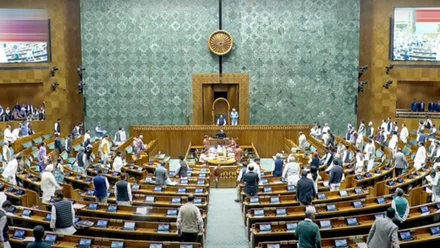
Context: In the Budget Session 2026–27, Lok Sabha applied the Guillotine to pass Demands for Grants worth ₹53 lakh crore. Only a few Ministries (like Agriculture and Railways) were discussed; the rest were passed without discussion.
About Guillotine
- The term “Guillotine” originally referred to a device used for execution by beheading during the French Revolution.
- In parliamentary practice, it means clubbing and putting remaining demands for grants to vote without discussion.
- In simple terms, it is a time-saving mechanism to ensure budget passage within deadlines.
Guillotine Procedure in Parliament
- After the Union Budget is presented, Parliament goes into a recess (~3 weeks).
- During this period, Department-related Standing Committees examine the Demands for Grants of various Ministries.
- After reassembly:
- The Business Advisory Committee (BAC) allocates time for discussion.
- Due to time constraints, only select key Ministries (e.g., Defence, Home, Agriculture, etc.) are discussed.
- Finally the Speaker applies the Guillotine and all remaining Demands for Grants (discussed or not) are put to vote together without debate.
Significance
- Ensures timely passage of the Budget.
- Prevents legislative delays and allows government functioning to continue smoothly.
- Reflects the balance between detailed scrutiny (via committees) and time-bound decision-making.
Solar Ingots & Wafers Policy

Context: India has announced that from June 2028, only domestically manufactured solar ingots and wafers will be allowed in certain solar projects to boost domestic manufacturing capacity.
What are Solar Ingots and Wafers?
- Solar ingots: Blocks of purified silicon used as raw material.
- Solar wafers: Thin slices cut from ingots, used to make solar cells.
- Flow: Ingot → Wafer → Solar Cell → Solar Module (panel)
Key Policy Measure
- Introduction of ALMM List-III (Approved List of Module Manufacturers) for ingots and wafers.
- ALMM is a mandatory registration mechanism (since 2019) under the Ministry of New and Renewable Energy (MNRE).
- From June 2028:
- Only ALMM-listed domestic ingots & wafers allowed in specified projects.
- Extends earlier rules (for cells and modules) to upstream components.
Applicability
- Applies to:
- Government-funded solar projects
- Open-access and net-metering projects
- Schemes like:
- PM Surya Ghar Yojana
- PM-KUSUM Scheme
- SECI tenders
- Only domestic products eligible for Production-Linked Incentive (PLI) schemes.
- Grandfathering provision: Projects already in pipeline are protected from new rules.
Significance
- Reduces import dependence (currently high for wafers and ingots).
- Strengthens Atmanirbhar Bharat in solar manufacturing.
- Builds complete domestic value chain in solar sector.
| Solar Capacity TargetsTarget: 280 GW solar capacity by 2030Installed (Nov 2025): ~132 GW |
Cotton Corporation of India (CCI)
Recent News
- Government approved ₹1,718.56 crore to Cotton Corporation of India (CCI) for MSP operations in 2023–24 season. The measure aims to stabilise cotton prices, prevent distress sales, and ensure better returns to farmers.
- India produced 325.22 lakh bales, contributing nearly 25% of global cotton output in 2023–24.
About CCI
- Cotton Corporation of India (CCI) was established in 1970 under Ministry of Textiles as a PSU.
- Functions under the Companies Act, 1956, focusing on cotton procurement and price stabilisation.
- Primary role is MSP operations when market prices fall below government-declared minimum support prices.
- Operates without quantitative limits, ensuring assured procurement for cotton farmers across India.
- Also undertakes commercial purchases to supply raw cotton to domestic textile industry during lean seasons.
New Particle Discovery by Large Hadron Collider (LHC)
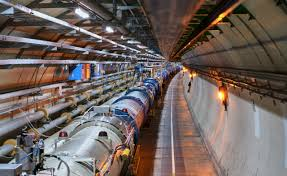
Context: Scientists at CERN’s Large Hadron Collider (LHC) discovered a new baryon named Xi-cc-plus particle.
About the discovery
- It is the 80th particle discovered by LHC, marking continued advances in particle physics research.
- The particle contains two charm quarks and one down quark, making it significantly heavier than protons.
- Discovery achieved with 7 sigma statistical significance, exceeding the 5 sigma threshold for confirmation.
- It is the first particle discovered after 2023 upgrades of the LHCb detector.
About Large Hadron Collider (LHC)
- The Large Hadron Collider (LHC) is the world’s largest and most powerful particle accelerator.
- Located at CERN near Geneva, spanning 27 km underground across France and Switzerland.
- It accelerates protons to near light speed and collides them to study fundamental particles.
- Enabled the discovery of the Higgs boson (2012), validating key predictions of particle physics.
Key Scientific Concepts
- Baryons: Particles made of three quarks (e.g., protons and neutrons).
- Quarks: Fundamental particles with six flavours such as up, down, charm, strange, top, bottom.
- The new particle differs from earlier ones due to heavier charm quarks replacing lighter up quarks.
Significance of the discovery
- Helps test Quantum Chromodynamics (QCD), the theory explaining the strong nuclear force.
- Provides insight into rare baryons and exotic particles like tetraquarks and pentaquarks.
- Enhances understanding of matter composition and fundamental forces in the universe.
