

National Medical Commission (NMC)
Context: NMC has proposed reforms to ease medical college norms while strengthening education quality.
More in News
- Draft amendments seek to simplify establishment norms for new medical colleges.
- Provision for a single-State licence for Armed Forces Medical Services (AFMS) doctors to practise nationwide.
- Emphasis on improving PG education standards through stricter criteria.
- Standalone PG institutes must maintain 220 beds with 80% occupancy.
- Private colleges restricted to a maximum of 4 PG seats for new courses.
About National Medical Commission (NMC)
- NMC is a statutory body established under the NMC Act, 2019.
- It replaced the Medical Council of India, marking a shift towards modern regulation.
- It regulates medical education and medical professionals across India.
- Headquarters is located in New Delhi.
- Structure
- The Commission comprises 33 members, ensuring diverse representation.
- It includes a Chairperson, ex-officio members, and part-time members.
- The Medical Advisory Council enables State participation in decision-making.
Functions of NMC
- Lays down policies to ensure high standards in medical education.
- Regulates institutions, professionals, and medical research activities.
- Grants recognition to medical qualifications and institutions.
- Oversees registration and monitors professional conduct.
- Ensures compliance by State Medical Councils.
- Promotes ethical practices and patient care standards.
- Frames guidelines for fee regulation in private institutions.
Autonomous Boards
- Under-Graduate Medical Education Board focuses on UG standards.
- Post-Graduate Medical Education Board regulates PG education.
- Medical Assessment and Rating Board ensures institutional quality.
- Ethics and Medical Registration Board oversees ethics and licensing.
Bharat Maritime Insurance Pool
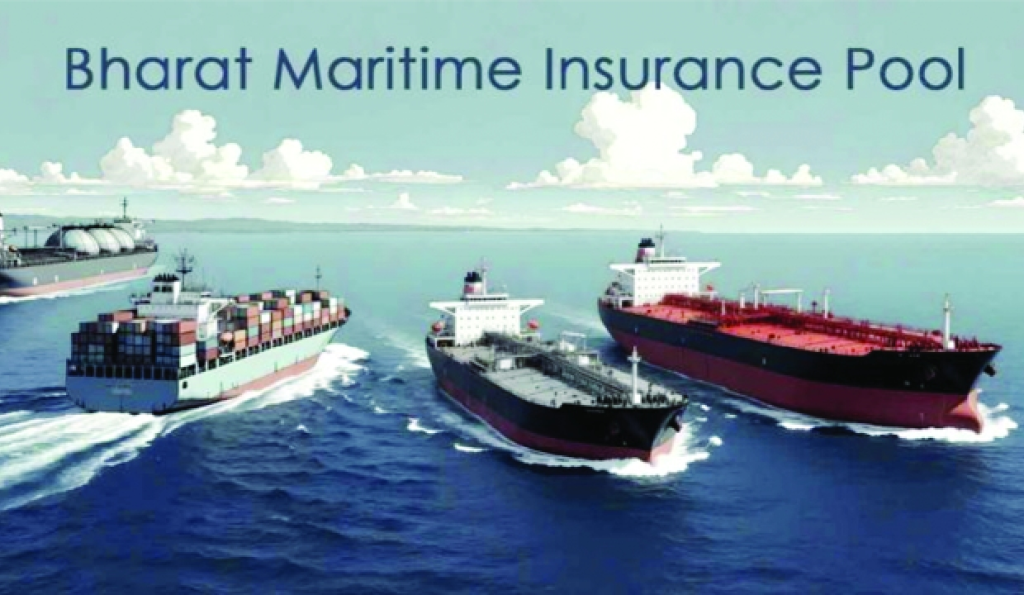
Context: The Union Government approved a Maritime Insurance Pool with ₹12,980 crore sovereign guarantee support.
Need for the Insurance Pool
- Rising geopolitical tensions near the Strait of Hormuz increased risks for global maritime trade.
- Marine insurance premiums rose sharply due to conflict uncertainty and stricter underwriting norms.
- Indian shipping firms faced higher operational costs and delays in obtaining insurance approvals.
- Dependence on foreign insurers created significant strategic vulnerability for India’s maritime sector.
Key Features of the Framework
- The scheme is backed by a sovereign guarantee, ensuring financial security and investor confidence.
- The framework will remain operational for 10 years, with a possible extension up to 15 years.
- It provides long-term stability in insurance coverage for shipowners and exporters.
- Facilitates partnerships with non-IG clubs to diversify risk-sharing mechanisms globally.
- Coverage and Scope
- The pool covers risks like hull damage, cargo loss, and war-related maritime threats.
- It includes Protection and Indemnity (P&I insurance) covering third-party liabilities and environmental damages.
- Coverage applies to India-flagged and India-controlled vessels engaged in global trade routes.
- Ensures uninterrupted shipping operations during geopolitical conflicts and maritime disruptions.
Strategic Significance
- Reduces dependence on foreign insurers, thereby lowering foreign exchange outflows over time.
- Strengthens India’s maritime resilience and ensures continuity of critical trade operations.
- Supports stable and secure movement of goods through global sea routes.
- Enhances India’s position within international shipping and logistics networks.
Archaeological Survey of India (ASI)
Context
- ASI issued a circular mandating only licensed tourist guides at protected monuments, triggering concerns among heritage practitioners.
- The move highlights regulatory control over heritage interpretation and management of protected sites.
About ASI
- ASI is the premier organisation responsible for archaeological conservation and heritage management in India.
- It functions under the Ministry of Culture and is the nodal agency for monument protection.
- Established in 1861 by Alexander Cunningham, regarded as the founder of Indian archaeology.
- Legal and Institutional Role
- Administers the Ancient Monuments and Archaeological Sites and Remains Act, 1958 (AMASR Act).
- Regulates construction and activities within prohibited and regulated areas around protected monuments.
- Plays a key role in implementing heritage preservation laws and guidelines.
- Organisational Structure
- Headed by a Director General, appointed by the Government of India.
- Headquarters located in New Delhi, with approximately 36 regional circles.
- Supported by specialised divisions like Excavation, Epigraphy, Science, and Conservation wings.
Core Functions of ASI
- Conducts systematic archaeological excavations and exploration across the country.
- Maintains and preserves over 3,600 centrally protected monuments.
- Engages in epigraphy and numismatics studies to decode historical records.
- Manages site museums and undertakes research and publication activities.
- Collaborates with UNESCO and international bodies for heritage conservation.
Sixth Schedule of Indian Constitution

About Sixth Schedule
- Provided under Article 244(2) and Article 275(1) of the Constitution.
- Applicable to tribal areas in Assam, Meghalaya, Tripura, Mizoram.
- Designed to ensure autonomy and cultural protection of tribal communities.
- Institutional Structure
- Governor is empowered to create Autonomous District Councils (ADCs) and Regional Councils.
- ADCs have a maximum of 30 members, including 4 nominated by Governor.
- Bodoland Territorial Council is an exception with 46 members.
- Regional Councils are created for multiple tribes within a district.
Powers of Councils
- Legislative Powers
- Councils can make laws on land, forests, shifting cultivation, and tribal customs.
- They regulate inheritance, marriage, and social practices within tribal communities.
- They control moneylending and trade by non-tribals in scheduled areas.
- Executive Powers
- Councils manage primary schools, health centres, markets, roads, and waterways.
- They can prescribe medium of instruction in primary education.
- Judicial Powers
- Councils establish village and district courts for dispute resolution.
- Jurisdiction excludes serious offences with higher punishments.
- High Courts and Supreme Court retain appellate authority.
- Financial Powers
- Councils prepare their own budgets and manage local finances.
- They can levy taxes on land, trade, and professions.
- They grant licences for mineral extraction within their jurisdiction.
Fifth Schedule vs Sixth Schedule
| Feature | Fifth Schedule | Sixth Schedule |
| Applicability & States | Applies to Scheduled Areas across multiple states in India. | Applies to tribal areas in 4 northeastern states (Assam, Meghalaya, Tripura, Mizoram). |
| Constitutional Basis | Provided under Article 244(1) of the Constitution. | Provided under Article 244(2) and Article 275(1). |
| Administrative Structure | Features Tribes Advisory Council (TAC) with advisory role only. | Features Autonomous District/Regional Councils with institutional authority. |
| Nature of Powers | Emphasises protective governance with Governor’s overriding control. | Ensures self-governance with legislative, executive, and judicial powers. |
| Financial & Legal Powers | Limited autonomy; no independent taxation or judicial framework. | Councils can levy taxes, manage budgets, and establish courts. |
| Special Feature (PESA) | PESA Act, 1996 applicable, strengthening grassroots democracy. | PESA not applicable, autonomy ensured through constitutional provisions. |
Mutual Fund Investor Awareness Fund
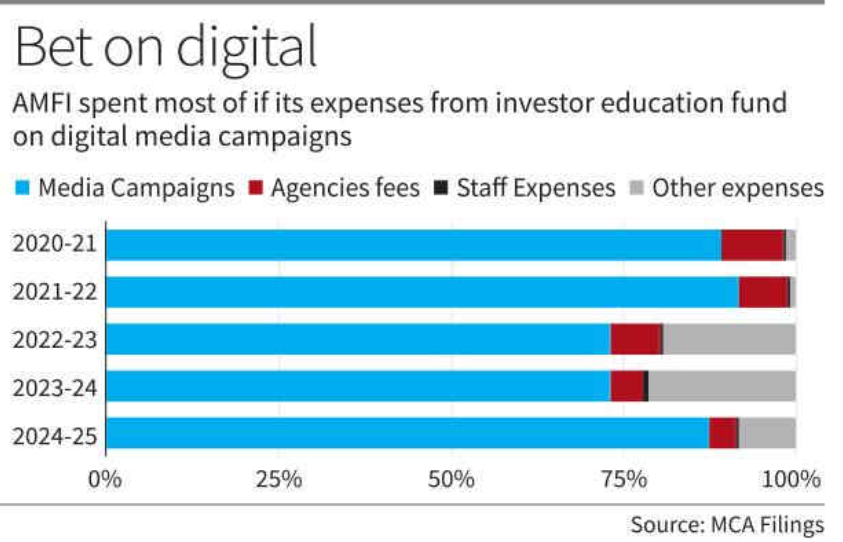
Context: Association of Mutual Funds in India (AMFI) spent nearly 90% funds on digital campaigns, raising concerns over effectiveness.
More in News
- AMFI utilised about ₹362.5 crore from investor awareness fund in FY 2024–25.
- Around 87.5% expenditure (~₹317 crore) was on digital campaigns and advertising agencies.
- Digital spending share remained consistently around 90% during 2020–21 to 2024–25 period.
- Total fund corpus exceeded ₹1,114 crore, indicating significant fund accumulation.
- Concerns raised that initiatives focus more on promotion bias than actual investor education.
Regulatory Framework
- Securities and Exchange Board of India (SEBI) mandates allocation of 0.02% of Assets Under Management (AUM) for investor education.
- Assets Under Management (AUM) refers to total investor funds managed by mutual funds.
- Half of this amount is utilised by Asset Management Companies (AMCs) for their own campaigns.
- Remaining portion is pooled with AMFI for industry-level awareness initiatives.
Issues Identified
- Excessive reliance on digital advertising instead of meaningful financial literacy programmes.
- Absence of outcome-based evaluation to measure actual improvement in investor awareness.
- Risk of form-over-substance compliance without enhancing investor decision-making capacity.
“Yellow Line” in Lebanon
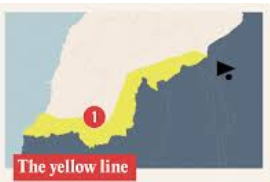
Context: Israel established a “Yellow Line” in southern Lebanon, marking a new operational boundary despite ongoing ceasefire arrangements.
What is the Yellow Line?
- It is a de facto boundary demarcated by Israel for military control and security purposes.
- Separates areas under Israeli presence from zones controlled by non-state actors like Hezbollah or Hamas.
- Not an internationally recognised border, but an operational military line.
Application in Different Regions
- In Gaza, the Yellow Line divides territory between Israeli-controlled areas and Hamas-controlled zones.
- In Lebanon, it separates Israeli forces from areas influenced by Hezbollah presence.
- Functions as a tool for enforcing ceasefire compliance and threat monitoring.
Strategic Significance
- Helps Israel maintain buffer zones in conflict-prone border regions.
- Reflects challenges in implementing ceasefire agreements in asymmetric conflicts.
- Indicates evolving nature of non-traditional boundaries in modern warfare.
Palk Strait and Adam’s Bridge (Ram Setu)
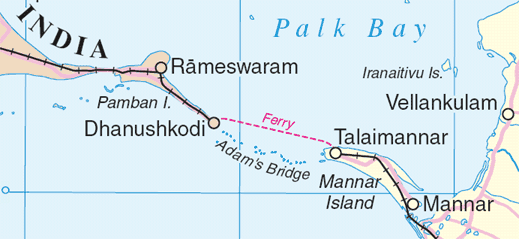
About Palk Strait
- Palk Strait is a narrow water body separating Tamil Nadu (India) from Sri Lanka. It is named after Robert Palk, a British administrator of the Madras Presidency.
- The strait connects Bay of Bengal in northeast with Gulf of Mannar in southwest.
- It is bordered by Pamban Island, Mannar Island, and Adam’s Bridge chain of shoals.
- The strait is shallow, with depths generally less than 100 metres, limiting navigation.
- Several rivers, including Vaigai River, drain into the strait.
- Jaffna, a major Sri Lankan city, lies along the coastal stretch of the strait.
- Geographic Features
- Length ranges between 64–137 km, forming a relatively narrow maritime passage.
- Southwestern portion of the strait is also known as Palk Bay.
- The region supports rich marine biodiversity, especially shrimp resources.
Adam’s Bridge (Ram Setu)
- Adam’s Bridge is a chain of limestone shoals connecting India and Sri Lanka.
- Extends between Rameswaram (India) and Mannar Island (Sri Lanka).
- Approximately 50 km long, linking Gulf of Mannar with Palk Strait.
- The area is extremely shallow, with depths of 1–10 metres, hindering navigation.
- Geological evidence suggests it was once a land connection between the two regions.
- Considered a natural formation due to tectonic activity and coral deposition.
- Cultural and Religious Significance
- In Hindu belief, it is identified as Ram Setu, built by Lord Rama’s army.
- In Islamic tradition, associated with Prophet Adam’s journey to Adam’s Peak.
Adjournment Sine Die
About
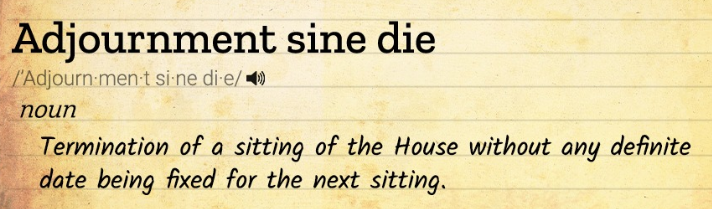
- Adjournment sine die refers to termination of sitting of a House without fixing a future date.
- The House is adjourned indefinitely, with no scheduled day for reassembly.
- Key Features
- It marks the end of session proceedings without formal prorogation at that moment.
- No specific date is announced for the next sitting of the House.
- Authority
- The power to adjourn sine die lies with the Presiding Officer of the House.
- Flexibility
- The Presiding Officer can reconvene sitting of the House at any time after such adjournment.
