

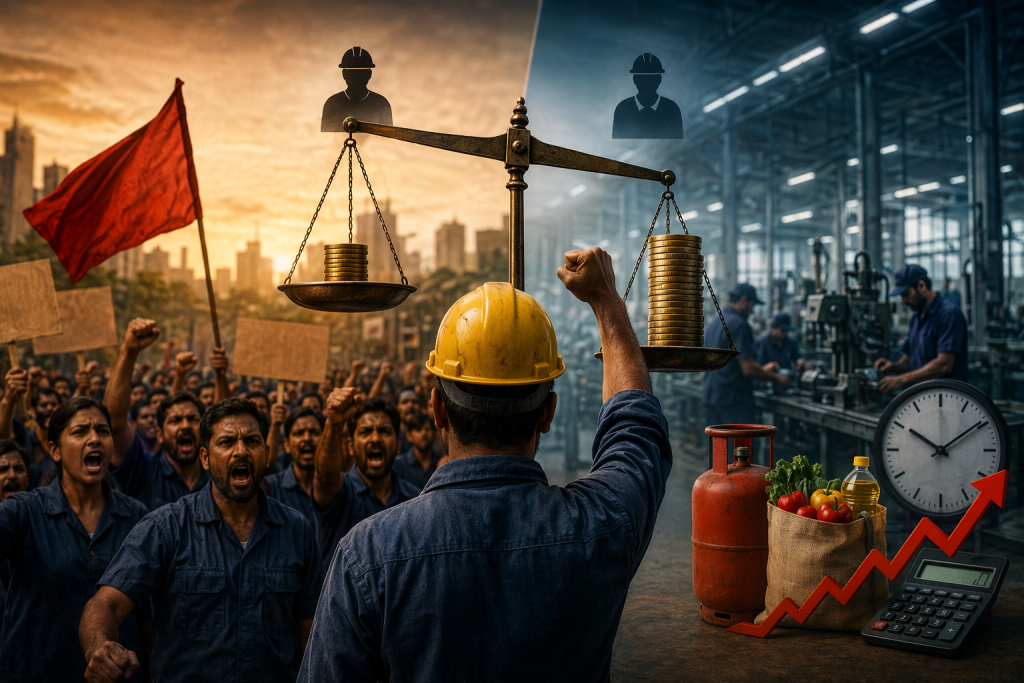
Context: The Noida workers’ protest reflects a deeper crisis where rising aspirations and economic realities of workers are colliding, exposing gaps in India’s labour governance framework.
Immediate Trigger: When Inequality Becomes Visible
- The sharp 35% wage hike in neighbouring Haryana acted as a tipping point, making wage disparities in Noida impossible to ignore.
- Workers performing similar jobs earned ₹11,000–₹13,000 in Noida, compared to nearly ₹19,000 in Haryana.
- What existed earlier as a silent disparity turned into a perceived injustice, triggering collective mobilisation.
- The protest was not sudden as it was the visible eruption of long-suppressed wage dissatisfaction.
Structural Causes: Beyond Immediate Triggers
- Inflation vs wages mismatch: Rising costs of LPG and essential goods turned stagnant wages into a survival challenge.
- Violation of labour norms: The eight-hour workday is routinely replaced by 12-hour shifts without proportional pay.
- Informalisation of workforce: Even in formal factories, workers lack contracts, reflecting hidden informality within formal sectors.
- Contractor exploitation: Middlemen reportedly skim wages, forcing workers into double shifts with single pay.
- Weak social security access: Difficulties in accessing EPF and insurance highlight implementation gaps in welfare systems.
Wage Determination: The Policy Reality
- Minimum wages are determined through a combination of base wage + Variable Dearness Allowance (VDA).
- The framework is guided by norms of the 15th Indian Labour Conference, ensuring subsistence for a standard family.
- Under the Code on Wages, 2019, a national floor wage is to act as a binding benchmark.
- However, the gap lies not in policy design, but in timely revision and enforcement.
Workers’ Demands: Assertion of Dignity
- Demand for ₹20,000 to ₹26,000 minimum wage to match cost of living.
- Enforcement of overtime pay and eight-hour work norms.
- Shift from contractor system to direct company hiring.
- Access to social security benefits and timely bonus payments.
- Improved working conditions, grievance redressal, and protection from workplace harassment.
Government Response: Balancing Growth and Stability
- Announced a 20–21% wage hike, implemented retroactively to provide immediate relief.
- Proposal to establish a Wage Board for long-term rationalisation of wages.
- Initiated labour audits to curb contractor exploitation and ensure compliance.
- Promoting direct bank transfers to eliminate wage leakage.
- Formation of local grievance committees for dispute resolution.
Way Forward
- Link wages with inflation dynamically to protect real incomes.
- Strengthen enforcement mechanisms through digital monitoring and inspections.
- Formalise employment relations by reducing dependence on contractors.
- Ensure universal social security coverage, especially for informal workers.
- Promote tripartite dialogue to balance interests of workers, industry, and State.
- Shift policy focus from job creation alone to creation of quality and secure jobs.
Conclusion
- The Noida protest is not an isolated event but a reflection of a broader transition in India’s labour economy. Sustainable growth will depend on ensuring that economic progress translates into fair wages, job security, and human dignity for workers.
