

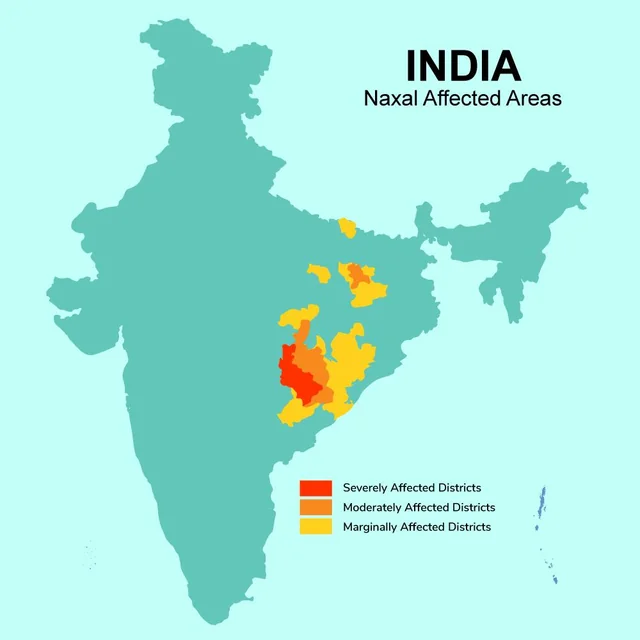
Context: Recent security operations and leadership losses have significantly weakened the CPI (Maoist), raising questions about the end of Left-Wing Extremism (LWE) in India.
Present Status: Decline of Maoist Insurgency
- Targeted operations like Operation Kagar (2024) led to large-scale neutralisation of cadres.
- Around 3,840 surrenders, 2,220 arrests, and 600 deaths indicate a decisive security push.
- Leadership collapse: Most Central Committee members eliminated; only two members remain active.
- Territorial contraction: From 180 districts (2013) to just Bijapur and Sukma in Chhattisgarh.
- The movement is now organisationally fragmented and operationally weakened.
- Yet, historical resilience suggests it cannot be declared completely eradicated.
- The Maoist movement has lost its military dominance and territorial control.
- However, underground networks and past resilience indicate latent revival potential.
- Some surrendered cadres may attempt reorganisation through overground networks.
- The movement has shifted from a security threat to a residual ideological challenge.
Historical Evolution of the Movement
- Originated from the Naxalbari uprising (1967) led by Charu Majumdar.
- Ideology based on Maoist revolutionary strategy, focusing on rural armed struggle.
- Revival through People’s War Group (PWG) in Andhra Pradesh under Kondapalli Seetharamaiah.
- Formation of CPI (Maoist) in 2004 created a unified insurgent structure.
- Establishment of PLGA (armed wing) transformed it into a guerrilla force.
Reasons for Rise and Expansion
- Land and inequality issues: Exploitation of landless peasants and tribal communities.
- Weak state presence: Governance vacuum in remote tribal areas.
- Mobilisation strategy: Recruitment of youth from universities and marginalised regions.
- Militarisation: Training, use of IEDs, and guerrilla tactics enhanced operational capability.
Reasons for Decline
- Sustained security operations: Special forces like Greyhounds and coordinated actions across States weakened strongholds.
- Leadership decapitation: Elimination and surrender of top leaders disrupted organisational continuity.
- Internal divisions: Ideological splits and factionalism weakened unity and long-term strategy.
- Tribal disconnect: Leadership remained largely non-tribal, creating representation gaps within the movement.
- Declining relevance of ideology: Welfare schemes and development reduced appeal of “class enemy” narrative.
- Democratic alternatives: Rise of electoral and protest-based politics reduced reliance on armed struggle.
Challenges in Complete Elimination
- Rehabilitation gaps: Effective reintegration of surrendered cadres remains uncertain.
- Legal complexities: Multiple criminal charges hinder smooth reintegration.
- Local grievances: Persistent socio-economic issues may still create fertile ground.
- Surveillance vs reintegration dilemma: Excessive monitoring may discourage mainstream integration.
Way Forward
- Development-led approach: Strengthen governance, infrastructure, and welfare delivery in tribal regions.
- Effective rehabilitation policy: Provide livelihood, legal support, and social integration for surrendered cadres.
- Community engagement: Build trust with tribal populations through participatory governance.
- Balanced strategy: Combine security measures with socio-economic interventions.
- Address root causes: Focus on land rights, livelihood security, and social justice.
Conclusion
- The Maoist insurgency is at its weakest phase, but not entirely eradicated. The long-term success lies in transforming the approach from security-centric to development-centric, ensuring justice, dignity, and inclusion for vulnerable communities.
