

Context
- Sri Ganganagar, Rajasthan touched 48°C making it India’s hottest recorded temperature this year.
- Frequency of heatwave spells has risen by 0.1 days per decade since 1961 over India’s Core Heatwave Zone.
- Maximum duration of heatwaves has increased by 0.55 days per decade across central, northwestern and eastern coastal regions.
About Urban Heat Island
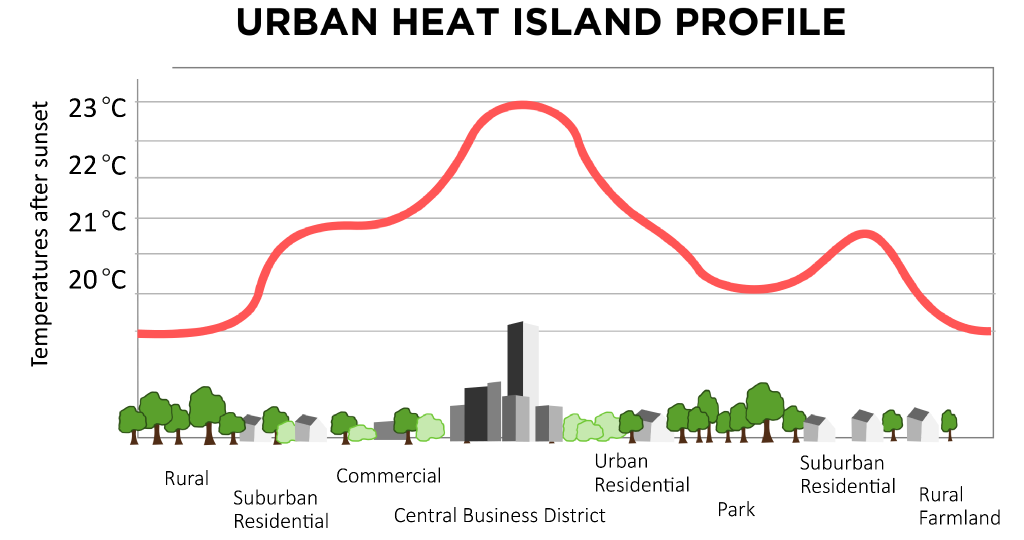
- An Urban Heat Island is a metropolitan area significantly warmer than its nearby rural surroundings.
- The effect is most noticeable in large densely populated cities like New Delhi, New York, Paris and London.
- Causes:
- Impervious Surfaces: Asphalt, concrete and steel absorb daytime heat and release it slowly at night due to low albedo.
- Loss of Vegetation: Limited green cover reduces evapotranspiration, cutting off natural cooling mechanisms completely.
- Anthropogenic Heat: Vehicular emissions, industrial processes and air conditioning release excess heat raising urban temperatures further.
- Air Pollution: Black carbon and particulate matter absorb solar radiation, worsening the UHI effect significantly.
- Urban Morphology: Dense buildings and narrow streets create an urban canyon effect, trapping heat within confined spaces.
Impacts of Rising Heat
- Heat Stress and Inequality:
- Many Indians in the informal sector work directly under the sun in completely unprotected environments.
- The instinct to reach for more and cheaper air conditioners shields the privileged at the expense of outdoor workers.
- Paradoxically, air conditioners are in a thermodynamic sense fuelling the urban heat problem further.
- Public Health:
- UHI increases heat strokes, dehydration and cardiovascular stress especially in vulnerable population groups.
- Higher temperatures boost ground level ozone formation, worsening smog and respiratory diseases significantly.
- Energy and Environment:
- UHI raises cooling energy use, straining power grids and increasing carbon emissions simultaneously.
- UHI accelerates evaporation, reducing water availability and increasing cooling water demand across cities.
- Excessive heat and reduced green spaces harm native vegetation, disrupt ecosystems and threaten urban wildlife.
Urban Planning, Governance and Policy Gaps
- India has not yet had a serious national conversation about dedicated budget heads for heat management.
- Labour laws requiring employers to stop outdoor work when the heat index crosses safe thresholds exist but are honoured largely in the breach.
- Heat Action Plans (HAPs) exist in cities like Ahmedabad but remain poorly funded and weakly implemented across India.
- Building codes have not been adequately calibrated to reflect India’s already shifted climate realities.
- Institutional preparedness for heat management remains fragmented across multiple ministries without a unified framework.
Mitigation and Climate-Resilient Urban Development
- Nature-Based Solutions:
- Mandating green cover and urban forestry can significantly reduce surface temperatures in dense urban areas.
- Blue-green infrastructure combining water bodies with vegetation provides effective passive cooling in cities.
- Replacing asphalt with permeable surfaces and plants reduces heat absorption and improves urban water management.
- Cool Infrastructure:
- Reflective roofing materials with high solar reflectance and thermal emittance can significantly reduce building temperatures.
- Passive cooling architecture through building orientation, natural ventilation and shading reduces dependence on energy-intensive air conditioning.
- Compact city planning with mixed land use reduces vehicle dependence and anthropogenic heat generation.
Global Case Studies:
- Los Angeles Cool Roof Initiative: Requires reflective roofing in all new buildings ensuring roofs effectively reflect sunlight and release absorbed heat.
- Dubai Smart Cooling: Chilled water generated centrally and distributed via underground pipes is 30-50% more energy-efficient than individual AC units.
- Paris Cool Streets Initiative: Converts streets into pedestrian zones and replaces asphalt with plants and trees increasing urban green space.
Way Forward for India:
- Urban design must mandatorily incorporate reflective materials and green cover through enforceable building codes.
- Smart Cities Mission must explicitly integrate heat resilience as a measurable outcome in all urban development projects.
- Labour law enforcement during peak heatwave periods must be treated as a non-negotiable public health obligation.
- India needs integrated urban climate governance with dedicated budgetary allocations specifically for heat management.
- Building truly just and inclusive heat-resilient cities requires centring the needs of outdoor workers and informal sector communities.
