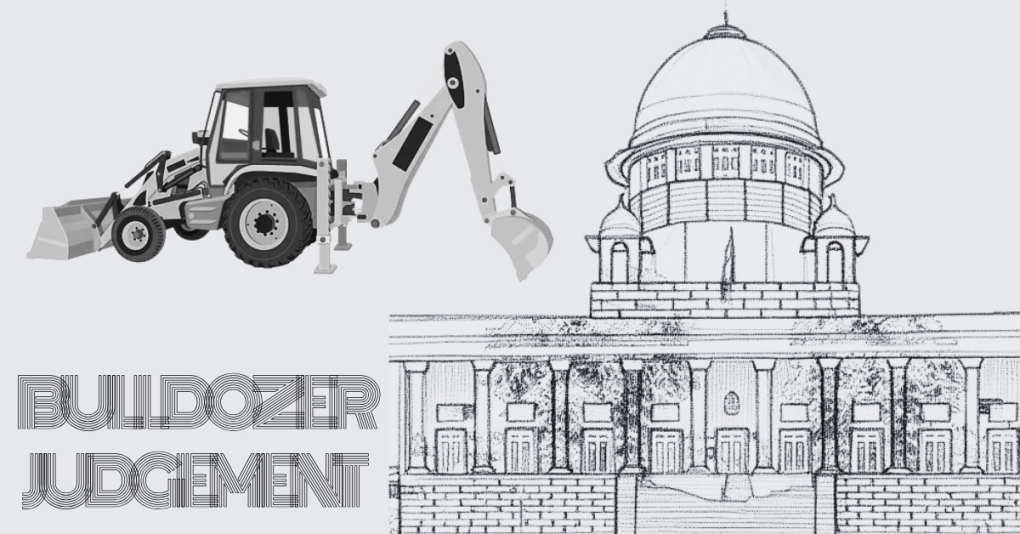
Context: The growing public endorsement of “bulldozer justice”, highlighted recently through symbolic political messaging, has revived concerns regarding the erosion of due process, constitutional safeguards, and rule of law principles in India.
Understanding ‘Bulldozer Justice’
- “Bulldozer justice” refers to the practice of demolishing properties of accused persons through executive action, often immediately after allegations of criminal activity.
- The phenomenon has increasingly emerged as a symbol of swift punitive governance and instant justice.
- Though popularly associated with recent political discourse, the use of bulldozers as instruments of state authority dates back to the Turkman Gate demolitions during the Emergency (1976).
Why ‘Bulldozer Justice’ Finds Public Support
- Delays in Judicial Delivery
- India’s judicial system faces severe pendency:
- Over 5.5 crore pending cases across courts
- More than 90,000 cases pending in the Supreme Court
- The India Justice Report 2025 noted that India has only 15 judges per million population, significantly below the Law Commission’s recommendation of 50 judges per million.
- India’s judicial system faces severe pendency:
- Demand for Instant Justice
- Lengthy litigation, procedural complexity, and slow investigation processes create public frustration.
- In an era shaped by expectations of instant outcomes and rapid governance delivery, executive action is often perceived as more effective than legal procedure.
- Political Symbolism and Public Perception
- Bulldozer action projects an image of strong leadership and zero tolerance towards crime, appealing to popular sentiment.
Associated Issues and Concerns
- Violation of Due Process
- Demolitions conducted before completion of investigation or trial undermine the foundational principle of presumption of innocence.
- Such actions bypass established legal safeguards and weaken procedural fairness.
- Erosion of Separation of Powers
- In bulldozer action, the executive effectively assumes the roles of investigator, judge, and executioner simultaneously.
- This concentration of authority undermines the constitutional principle of checks and balances.
- Threat to Rule of Law
- A constitutional democracy derives legitimacy from lawful procedure rather than executive spectacle.
- Extrajudicial punitive actions risk normalising governance based on majoritarian impulses instead of constitutional morality.
- Selective and Arbitrary Enforcement
- If demolitions are justified on municipal or land-use violations, questions arise regarding administrative failure and selective targeting.
- The absence of uniform standards raises concerns of discriminatory enforcement and abuse of state power.
- Institutional Credibility Crisis
- Excessive reliance on executive coercion weakens citizens’ trust in judicial institutions and lawful dispute resolution mechanisms.
Constitutional and Legal Dimensions
- The Indian constitutional framework guarantees:
- Article 14: Equality before law
- Article 21: Protection of life and personal liberty through due process
- Arbitrary demolitions without adequate legal procedure may violate principles of:
- Natural justice
- Proportionality
- Procedural fairness
- The Supreme Court has repeatedly emphasised that state action must remain within constitutional boundaries, irrespective of public pressure.
Way Forward
- Strengthen Judicial Infrastructure
- Increase judicial appointments to reduce pendency and improve access to timely justice.
- Expand fast-track courts for heinous and high-priority criminal cases.
- Improve Investigative Capacity
- Modernise police investigation systems and strengthen prosecutorial efficiency for quicker disposal of cases.
- Ensure Accountability in Executive Action
- Any demolition or punitive administrative action must strictly follow judicial oversight and statutory procedure.
- Promote Constitutional Culture
- Public discourse should reinforce respect for rule of law, due process, and institutional accountability.
- Balance Speed with Fairness
- Governance reforms should focus on efficient legal delivery mechanisms rather than bypassing legal institutions.
Conclusion
- “Bulldozer justice” may satisfy public demand for immediate retribution, but it risks undermining the constitutional foundations of fairness, accountability, and rule of law. A democratic state derives legitimacy not from the speed of punishment, but from the integrity, impartiality, and legality of its processes. India’s long-term democratic strength will depend on strengthening institutions capable of delivering swift yet constitutionally compliant justice.