

Context: The recent conflict in West Asia has highlighted India’s growing vulnerability to global energy supply disruptions, particularly due to its heavy dependence on imported crude oil.
Understanding India’s Energy Dependence
- India imports over 85% of its crude oil requirements, making it highly exposed to external geopolitical and price shocks.
- Approximately 45% of India’s crude imports transit through the Strait of Hormuz, one of the world’s most critical maritime chokepoints.
- India has emerged as the world’s third-largest oil consumer, with demand projected to rise to:
- 5.74 million barrels/day (2025)
- 5.99 million barrels/day (2026)
- According to the IEA, India’s crude demand growth is expected to outpace China’s, making India a key driver of global energy demand growth.
Changing Global Energy Landscape
- Impact of Geopolitical Conflicts
- The Russia–Ukraine War and the West Asia conflict exposed vulnerabilities in the existing global energy architecture.
- Brent crude prices surged to nearly $120/barrel during the conflict, transmitting inflationary pressures globally.
- The International Energy Agency described the present crisis as more severe than the combined energy shocks of 1973, 1979, and 2022.
- Strategic Responses by Major Economies
- Europe reduced dependence on Russian gas by diversifying suppliers and expanding LNG infrastructure.
- China secured long-term LNG contracts, while Japan and South Korea expanded strategic petroleum reserves.
India’s Strategic Adaptation and Diversification
- India has demonstrated considerable agility in responding to global energy disruptions.
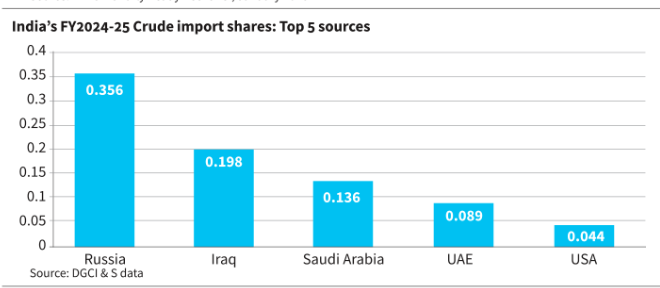
- Before 2022, Russia accounted for barely 2% of India’s crude imports; by FY2024-25, its share rose to nearly 36%, making it India’s largest supplier.
- India’s import basket now includes diversified suppliers such as:
- Russia
- Iraq
- Saudi Arabia
- UAE
- United States
- This diversification has increased India’s strategic room for manoeuvre in a fragmented energy market.
Associated Challenges and Structural Risks
- High Import Dependence
- India’s crude oil dependence reached nearly 89.4% in FY2024-25, exposing the economy to fluctuations in:
- Crude prices
- Freight costs
- Currency exchange rates
- India’s crude oil dependence reached nearly 89.4% in FY2024-25, exposing the economy to fluctuations in:
- Maritime and Geopolitical Vulnerability
- Strategic chokepoints such as the Strait of Hormuz continue to constrain India’s energy security.
- During regional tensions, Indian LPG carriers required naval escort under Operation Sankalp, highlighting maritime vulnerabilities.
- Inflationary and Macroeconomic Pressures
- Supply disruptions are projected to reduce India’s GDP growth from 7.4% (FY26) to 6.5% (FY27) while increasing inflation from 2.3% to 4.4%.
- Emerging Vulnerabilities in Energy Transition
- India’s transition towards renewable energy, EVs, and battery storage creates new dependencies on:
- Lithium
- Cobalt
- Nickel
- Rare earth minerals
- China currently controls over 91% of global rare-earth processing, while India processes less than 5% of projected 2035 battery-grade mineral requirements domestically.
- India’s transition towards renewable energy, EVs, and battery storage creates new dependencies on:
Why Energy Security Requires Strategic Resilience
- Energy Security Beyond Price
- Modern energy security is no longer limited to procuring the cheapest fuel, but includes:
- Supply resilience
- Diversification
- Macroeconomic stability
- Modern energy security is no longer limited to procuring the cheapest fuel, but includes:
- Importance of Strategic Reserves
- Countries such as Japan maintain petroleum reserves equivalent to 254 days of consumption, reflecting the growing importance of strategic stockpiling.
- Balancing Growth and Sustainability
- India’s expanding economy requires stable energy access while simultaneously pursuing climate and decarbonisation goals.
Way Forward
- Expand Strategic Petroleum Reserves (SPR) to cushion against sudden supply disruptions.
- Diversify Import Sources and Supply Routes to minimise geopolitical concentration risks.
- Strengthen Maritime Security through naval preparedness and protection of sea lanes.
- Reduce Oil Intensity in Transport through public transport expansion, EV adoption, and fuel efficiency measures.
- Accelerate Renewable Energy Transition while ensuring adequate storage and grid infrastructure.
- Develop Critical Mineral Ecosystem through domestic exploration, processing capacity, and international partnerships.
- Promote Energy Diplomacy to secure long-term supply agreements and strategic partnerships.
Conclusion
- The evolving global energy landscape demonstrates that energy security can no longer be viewed merely through the lens of affordability or supply availability. For India, the challenge lies in balancing economic growth, strategic autonomy, and sustainability amid an increasingly fragmented geopolitical environment. The future of India’s energy security will depend on its ability to transition from import dependence towards strategic resilience and diversified energy preparedness.
