

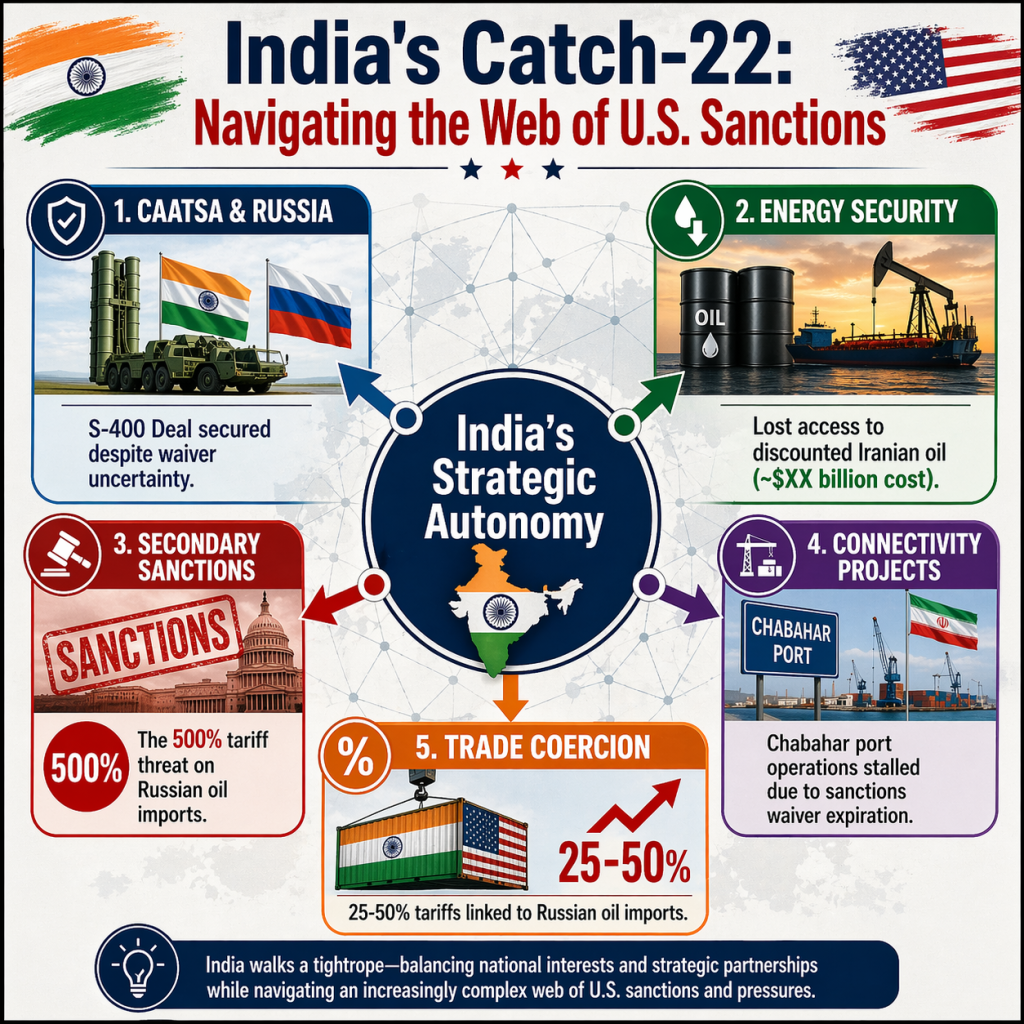
Context: The ongoing U.S.-Israel–Iran conflict and the resulting energy disruptions and inflationary pressures have exposed India’s vulnerability to U.S. unilateral sanctions and geopolitical shocks.
Nature of U.S. Sanctions
- The U.S. has imposed 365 sanctions in the present century, far exceeding other global actors.
- These sanctions span 23 countries and multiple issue-based regimes, unlike the limited UN-led multilateral sanctions.
- India’s compliance trajectory: India halted or reduced imports of Iranian, Venezuelan, and Russian oil under U.S. pressure.
- Frequent waivers, renewals, and reversals create a “whack-a-mole” sanction environment, complicating long-term planning.
- India’s choices increasingly reflect reactive compliance rather than strategic autonomy.
Economic and Strategic Costs for India
- Macroeconomic stress: Rising energy bills, shipping costs, inflation, and export decline (~7%) indicate tangible economic impact.
- Currency and growth implications: Rupee depreciation has affected India’s global economic ranking and growth projections.
- Opportunity costs: Forgone access to discounted Iranian and Venezuelan crude has resulted in significant economic losses.
- Strategic connectivity loss: Delays in projects like Chabahar Port and International North-South Transport Corridor (INSTC) have weakened India’s regional connectivity options.
- Energy security constraints: Sanctions have hindered efforts to diversify energy sources, increasing dependence on volatile routes like Hormuz.
Limits of Compliance
- Compliance increases coercion: Yielding to sanctions has not reduced pressure but has led to additional demands from the U.S..
- Selective resistance yields gains: India’s decision to proceed with S-400 procurement despite CAATSA threats proved strategically beneficial.
- Erosion of multilateralism: Compliance with unilateral sanctions weakens the UN-based rules-based order.
- Impact on foreign policy autonomy: Continued compliance risks aligning India’s decisions with external geopolitical priorities.
Way Forward
- India must adopt a firm stance against unilateral sanctions that undermine national interests.
- Strengthen ties with multiple suppliers to reduce single-source dependence.
- Expand mechanisms like rupee-based trade, BRICS payment systems, and insulated financial channels.
- Invest in renewable energy and alternative fuels to reduce import dependence.
- Position India as a voice against coercive economic measures in global governance.
- Fast-track connectivity initiatives like Chabahar and INSTC for long-term geopolitical leverage.
Conclusion
- U.S. unilateral sanctions represent not just an economic challenge but a test of India’s strategic autonomy and policy independence. As seen in the past (e.g., PL-480 crisis leading to Green Revolution), India must convert external pressure into an opportunity for self-reliance, diversification, and assertive diplomacy.
