

Delimitation CommissionDelimitation Commission – Constitutional Provisions (Article 82, 170), Amendments, and Process

About Delimitation Commission
- The Delimitation Commission is a statutory and quasi-judicial body constituted by the Government of India.
- Its primary responsibility is to redraw the boundaries of Lok Sabha and State Assembly constituencies based on the latest Census.
- This process ensures that each constituency represents roughly an equal population, thereby strengthening democratic equality.
- The Commission functions with a high degree of independence:
- Its decisions are final and have the force of law.
- These decisions cannot be challenged in any court, ensuring neutrality in the process.
- Delimitation Acts
- India has enacted Delimitation Acts in 1952, 1962, 1972, and 2002, each linked to a Census.
- These Acts led to the constitution of Delimitation Commissions to restructure constituencies and update reservations.
Constitutional Provisions
- Article 82 empowers Parliament to enact a Delimitation Act after every Census.
- Article 170 provides for readjustment of State Assembly seats.
- Articles 330 and 332 ensure reservation of seats for SCs and STs based on population.
- Article 327 gives Parliament the power to legislate on election matters.
- Article 329(a) bars judicial interference in delimitation orders.
- Key Constitutional Amendments
- The 42nd Amendment (1976) froze the total number of seats to encourage population control.
- The 84th Amendment (2002) extended this freeze till 2026, while allowing internal adjustments.
- The 87th Amendment (2003) mandated the use of the 2001 Census for delimitation and SC/ST reservation.
- Together, these amendments ensure stability in representation, though they delay adjustment to current population realities.
Composition
- The Commission is headed by a retired Judge of the Supreme Court.
- It includes the Chief Election Commissioner and State Election Commissioners as members.
- Associate Members (MPs/MLAs) participate in discussions, but do not have voting powers.
Criteria for Delimitation
- The Commission follows a balanced approach while drawing boundaries:
- It ensures equal population representation across constituencies.
- It maintains geographical compactness, avoiding fragmented areas.
- It respects natural features like rivers and hills.
- It considers administrative convenience, avoiding unnecessary division of districts or tehsils.
- It allocates SC/ST reserved seats proportionately.
- It invites public feedback before finalising boundaries.
Al-Aqsa Mosque and Jerusalem – Geopolitical and Religious Significance

About Al-Aqsa Mosque
- Al-Aqsa Mosque (“the Farthest Mosque”) is the third holiest site in Islam.
- It is located in the Old City of Jerusalem.
- The mosque is situated on the Temple Mount, known in Islam as:
- Al-Aqsa Compound or
- Haram esh-Sharif
- It was built several decades after Prophet Muhammad’s death.
- Religious Significance:
- Islamic belief holds that Prophet Muhammad was taken from the Great Mosque of Mecca to Al-Aqsa during the Night Journey (Isra and Mi’raj).
- Initially, Muslims offered prayers facing this site until about the 16th–17th month after migration (Hijra).
- Later, the direction of prayer (Qibla) was changed to the Kaaba in Mecca.
About Jerusalem
- Jerusalem is located in Western Asia.
- It lies on a plateau in the Judaean Mountains, between the Mediterranean Sea and the Dead Sea.
- It is one of the oldest continuously inhabited cities in the world.
- The city is surrounded by:
- Mount of Olives (East)
- Mount Scopus (North-East)
- Religious Importance:
- Jerusalem is sacred to Judaism, Christianity, and Islam.
- Geopolitical Features
- Jerusalem lies along the Green Line, dividing Israel and the West Bank.
- Both Israel and Palestine claim Jerusalem as their capital.
- These claims are not widely recognised internationally, reflecting an ongoing dispute.
Important Landmarks and Recognition
- The Old City of Jerusalem:
- Declared a UNESCO World Heritage Site (1981)
- Listed as a World Heritage Site in Danger (since 1982)
- Mount Herzl:
- Located in western Jerusalem
- Serves as the national cemetery of Israel
UNIFIL – Mandate, Composition, and India’s Contribution to Peacekeeping
About UNIFIL
- United Nations Interim Force in Lebanon is a UN peacekeeping force established in March 1978 by the UN Security Council.
- It was created after Israel’s invasion of Lebanon during the South Lebanon Conflict.
- Original Mandate:
- To confirm Israeli withdrawal from Lebanon
- To restore international peace and security
Mandate and Functions
- Following the 2006 Israel–Hezbollah war (34 days), UNIFIL’s mandate was expanded.
- It now:
- Monitors the cessation of hostilities
- Supports the deployment of Lebanese Armed Forces in southern Lebanon
- Helps maintain peace and stability in the region
- Rules of Engagement: Use of force is permitted only in self-defence or for carrying out assigned duties
Structure and Contribution
- UNIFIL consists of around 10,500 peacekeepers.
- Troops are contributed by 48 countries.
- Major contributors include:
- Indonesia (largest contributor)
- Italy, India, Nepal, and China
Cancer Therapies – Immunotherapy, PD-1 Inhibitors, Keytruda, and CAR-T Cell Therapy

Context
- A major investigation revealed leakage and circulation of fake high-cost cancer drug Keytruda in India. The case highlights concerns related to drug authenticity, hospital supply chains, and affordability of cancer therapies.
About Cancer Drugs (Keytruda Example)
- Keytruda is the brand name of Pembrolizumab, an immunotherapy drug.
- It is used for treating multiple cancers such as:
- Melanoma
- Lung cancer
- Cervical cancer
- Renal cell cancer
- It belongs to a class of drugs called PD-1 inhibitors (checkpoint inhibitors).
- Mechanism:
- It works by blocking PD-1 receptors on T-cells, preventing cancer cells from evading the immune system.
- This enables the body’s immune system to identify and destroy cancer cells.
- Approval and Market:
- First approved in 2014 (USA).
- One of the best-selling cancer drugs globally.
Types of Cancer Therapies
- Immunotherapy
- It trains the immune system to recognise and attack cancer cells.
- It is highly targeted and may have long-lasting effects, sometimes even after treatment stops.
- Includes:
- Checkpoint inhibitors (e.g., Keytruda)
- CAR-T cell therapy → modifies patient’s T-cells to attack cancer
- mRNA vaccines (under development)
- Chemotherapy and Radiation
- These therapies directly kill cancer cells and some healthy cells.
- They are less targeted compared to immunotherapy.
- Targeted Therapy (Monoclonal Antibodies)
- Drugs like Keytruda are monoclonal antibodies, designed to target specific molecules on cancer cells.
Issues
- Cost and Accessibility
- Keytruda is extremely expensive:
- Around ₹1.5 lakh per vial
- Monthly treatment cost can reach ₹3–4 lakh
- Keytruda is extremely expensive:
- Access is limited due to:
- High cost of biologic drugs
- Patent protection (expiry expected around 2028)
- Limited insurance coverage
Sabarimala Temple – History, Traditions, and Supreme Court Judgment on Women Entry
About Sabarimala Temple
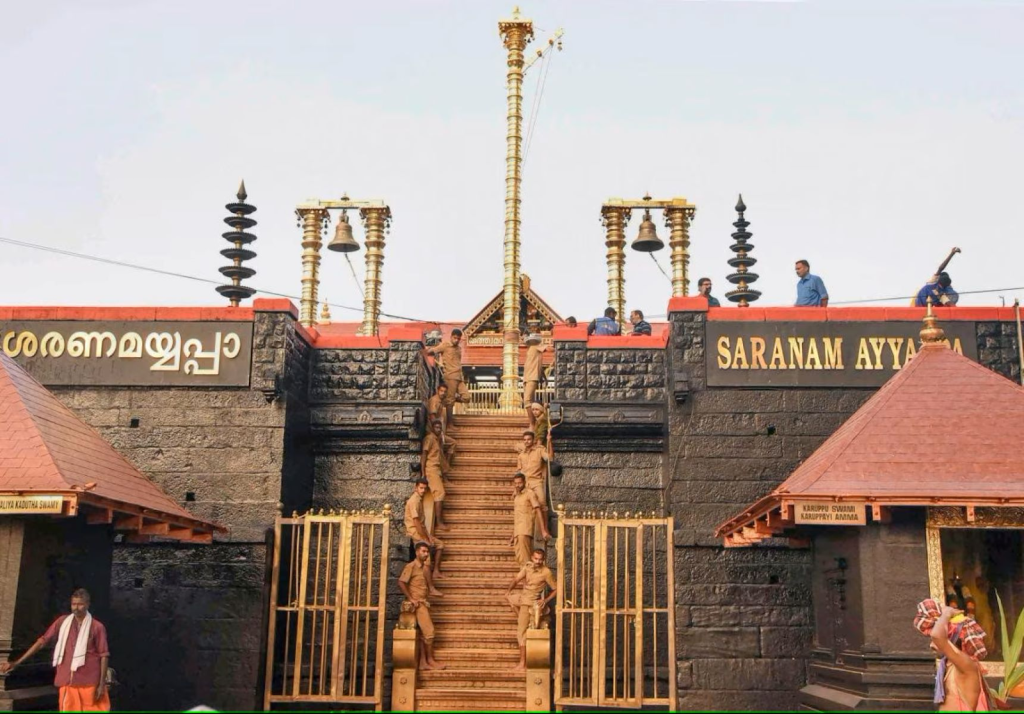
- The Sabarimala Sri Ayyappa Swami Temple is a major pilgrimage centre in Kerala, dedicated to Lord Ayyappa.
- The temple opens only during specific periods, especially the Mandalam–Makaravilakku season (November–January).
- Devotees undertake a 41-day vrat (fast) before visiting the temple.
- Pilgrimage practices include:
- Wearing black robes
- Carrying Irumudi (sacred twin bags)
- Chanting “Swami Sharanam Ayyappa”
- The temple also houses shrines of:
- Vavar Swami (Muslim saint)
- Malikappuram Devi
- This reflects a tradition of religious harmony and inclusiveness.
Location
- The temple is located in Pathanamthitta district (Kerala), in the Sabari Hills of the Western Ghats.
- It lies within the Periyar Tiger Reserve, surrounded by 18 hills.
- The temple is situated at an altitude of about 914 metres.
Architecture and Structure
- The temple follows traditional Kerala-style architecture, known for its simplicity and spiritual design.
- The sanctum houses the idol of Lord Ayyappa in a yogic posture.
- The temple has a gold-plated roof (copper-plated).
- A key feature is the 18 sacred steps (Pathinettam Padi):
- Symbolise 18 hills or 18 virtues
- Covered with gold plating
- Other features:
- Presence of a lamp post
- Smaller shrines around the main deity
- The temple was rebuilt after a fire in 1950.
Historical and Cultural Aspects
- The temple is believed to be around 800 years old.
- It is associated with the legend of Ayyappa, son of Shiva and Mohini (form of Vishnu), who defeated Mahishi.
- It is believed to have been built by King Rajasekhara.
- Vavar Swami, a Muslim warrior, is revered as a companion of Ayyappa, symbolising communal harmony.
- The Makaravilakku (Jyoti Darshan) ceremony holds great religious significance.
Women Entry Issue
- Traditionally, women aged 10–50 years were not allowed entry, as Lord Ayyappa is considered a perpetual celibate (Naishtika Brahmachari).
- 1991 → Kerala High Court upheld this restriction.
- 2006 → Indian Young Lawyers Association filed a petition in the Supreme Court.
- Supreme Court Judgment
- On 28 September 2018, the Supreme Court (4:1 majority) declared the restriction unconstitutional.
- It held that the ban violated:
- Article 14 (Equality)
- Article 15 (Non-discrimination)
- Article 25 (Freedom of religion)
- The Court ruled that:
- The practice is not an essential religious practice.
- Women have the right to worship.
Pradhan Mantri Awas Yojana (PMAY) – Features, Components, and Implementation
Overview
- PMAY is a flagship housing scheme launched in:
- 2015 (PMAY–Urban)
- 2016 (PMAY–Gramin)
- The scheme aims to provide affordable pucca houses with basic amenities to the poor.
- It reflects a shift from mere shelter provision to holistic habitat development, including sanitation, energy access, and livelihood linkages.
PMAY–Gramin (PMAY-G)
- Implemented by the Ministry of Rural Development, PMAY-G focuses on houseless households and those living in kutcha or dilapidated houses.
- It ensures that beneficiaries receive not just a house, but a livable and dignified dwelling space.
- Targeting and Inclusion
- Beneficiaries are selected using SECC 2011 data, with final verification by the Gram Sabha, ensuring transparency and community participation.
- The scheme prioritises: Landless households and SC/ST communities (minimum 60% allocation at national level)
- Financial Support and Design
- Each house must have a minimum area of 25 sq. m, including a hygienic cooking space.
- Financial assistance provided:
- ₹1.20 lakh in plain areas
- ₹1.30 lakh in hilly/difficult areas
- Funding pattern:
- 60:40 between Centre:State
- 90:10 for North Eastern and Himalayan states
- 100% for Union Territories
- Implementation is strengthened through digital platforms:
- AwaasSoft MIS
- AwaasApp, ensuring transparency and real-time tracking
PMAY–Urban (PMAY-U)
- Implemented by the Ministry of Housing and Urban Affairs, PMAY-U aims to provide affordable housing to urban poor, including slum dwellers.
- It is implemented as a Centrally Sponsored Scheme, except for the Interest Subsidy Scheme, which is a Central Sector Scheme.
- Key Components
- Beneficiary Led Construction (BLC)
- Affordable Housing in Partnership (AHP)
- Affordable Rental Housing (ARH)
- Interest Subsidy Scheme (ISS)
- Eligibility and Coverage
- The scheme covers EWS, LIG, and MIG households.
- A key condition is that the beneficiary must not own a pucca house anywhere in India.
- Additional provisions:
- Houses of 21 sq. m can be expanded to 30 sq. m
- Ownership is preferably in the name of an adult female member or jointly, promoting gender empowerment
- Coverage extends to:
- All statutory towns (Census 2011)
- Towns notified subsequently by States
- Funding pattern:
- 60:40 between Centre:State
- 90:10 for North Eastern and Himalayan states
- 100% for Union Territories
- The scheme converges with multiple initiatives such as:
- Smart Cities Mission
- Swachh Bharat Mission (Urban)
- National Urban Livelihoods Mission
- PM SVANidhi, Ayushman Bharat, Ujjwala Yojana, PM Vishwakarma
- The Technology Innovation Sub-Mission (TISM) promotes: Green, disaster-resilient, and cost-effective construction technologies
GLP-1 Receptor Agonists – Mechanism, Clinical Outcomes, and Public Health Implications

Context
- The entry of GLP-1 based weight-loss drugs such as semaglutide (by Novo Nordisk) and tirzepatide (by Eli Lilly) in India reflects a growing shift towards advanced pharmacological management of obesity.
- These drugs have demonstrated 15–20% body weight reduction, making them comparable to bariatric surgery outcomes, and thus highly relevant in public health discussions.
About GLP-1 Drugs
- GLP-1 drugs are GLP-1 receptor agonists, a class of medicines used to manage type-2 diabetes and obesity.
- They mimic incretins, which are natural gut hormones responsible for regulating blood sugar and appetite.
- Key drugs:
- Semaglutide
- Tirzepatide
- New drugs under development:
- Retatrutide
- CagriSema
- Survodutide
- These therapies also provide additional health benefits, including improvement in:
- Cardiovascular diseases
- Kidney diseases
- Non-alcoholic fatty liver disease (NAFLD)
- Obstructive sleep apnea
Mechanism of Action
- GLP-1 receptor agonists act through multiple coordinated pathways:
- They enhance insulin secretion, improving glucose utilisation.
- They inhibit glucagon release, thereby reducing glucose output from the liver.
- They slow gastric emptying, preventing sudden spikes in blood glucose.
- They suppress appetite, creating a sense of satiety.
- Tirzepatide has an additional mechanism:
- It also mimics GIP (glucose-dependent insulinotropic polypeptide), enhancing metabolic regulation.
- Semaglutide:
- Developed as a weekly injectable formulation
- Demonstrated higher effectiveness
- Approved for obesity management in 2021
Clinical Outcomes
- These drugs show significant therapeutic benefits:
- Weight loss:
- Semaglutide → ~15% body weight reduction
- Tirzepatide → up to 20% weight loss
- Cardiovascular benefits:
- Reduction in major cardiovascular events by 20%
- Reduction in all-cause mortality by 19%
- Liver-related benefits:
- Resolution of fatty liver in 63% cases
- Improvement in liver fibrosis in 37% cases
- Weight loss:
Export Inspection Council (EIC) – Role in Quality Control and Export Certification

Context: The Export Inspection Council (EIC) plays a crucial role in ensuring that Indian exports meet global quality and safety standards, thereby strengthening India’s credibility in international trade.
About Export Inspection Council
- The Export Inspection Council is a statutory body established by the Government of India under the Export (Quality Control and Inspection) Act, 1963.
- It functions as the official export certification body of India.
- Its primary role is to ensure the sound development of export trade through quality control and inspection mechanisms.
- Organisational Structure:
- Headed by a Chairman
- Executive Head → Director of Inspection & Quality Control (responsible for day-to-day functioning)
- Administrative Details:
- Nodal Ministry → Ministry of Commerce and Industry
- Headquarters → New Delhi
- Core Functions
- The Council ensures that products notified under the Export (Quality Control and Inspection) Act, 1963:
- Meet the quality and safety standards of importing countries
- Comply with international trade requirements
- The Council ensures that products notified under the Export (Quality Control and Inspection) Act, 1963:
Certification Mechanism
- Mandatory certification is required for several food products, including:
- Fish and fishery products
- Dairy products
- Honey
- Egg products
- Meat and poultry products
- Animal casing, gelatine, ossein, crushed bones
- Feed additives and pre-mixtures
- For other food and non-food products, certification is voluntary.
- The Council operates through Export Inspection Agencies (EIAs) located at: Mumbai, Kolkata, Kochi, Delhi, and Chennai
National Productivity Council (NPC) – Objectives, Functions, and Asian Productivity Organisation

About National Productivity Council
- The National Productivity Council was established in 1958 as an autonomous organisation.
- It functions under the Department for Promotion of Industry and Internal Trade (DPIIT), Ministry of Commerce and Industry.
- NPC is a multipartite, non-profit organisation, which ensures balanced representation from:
- Government
- Employers’ organisations
- Workers’ organisations
- Technical and professional institutions
- Headquarters: New Delhi
- It is a constituent of the Asian Productivity Organisation (APO), a Tokyo-based intergovernmental body, of which India is a founding member.
Objectives of NPC
- To create awareness about productivity concepts and techniques across sectors.
- To strengthen the microeconomic foundations of economic development.
- To function as a think tank for the Government on productivity-related issues.
- To provide high-quality consultancy and training services.
- To enhance the overall focus on productivity and efficiency in the economy.
Core Functions
- NPC supports organisations through:
- Consultancy services for productivity improvement
- Training programmes for personnel at different levels
- Dissemination of knowledge through seminars, workshops, and conferences
- Productivity research and database development
- Publications related to productivity enhancement
