

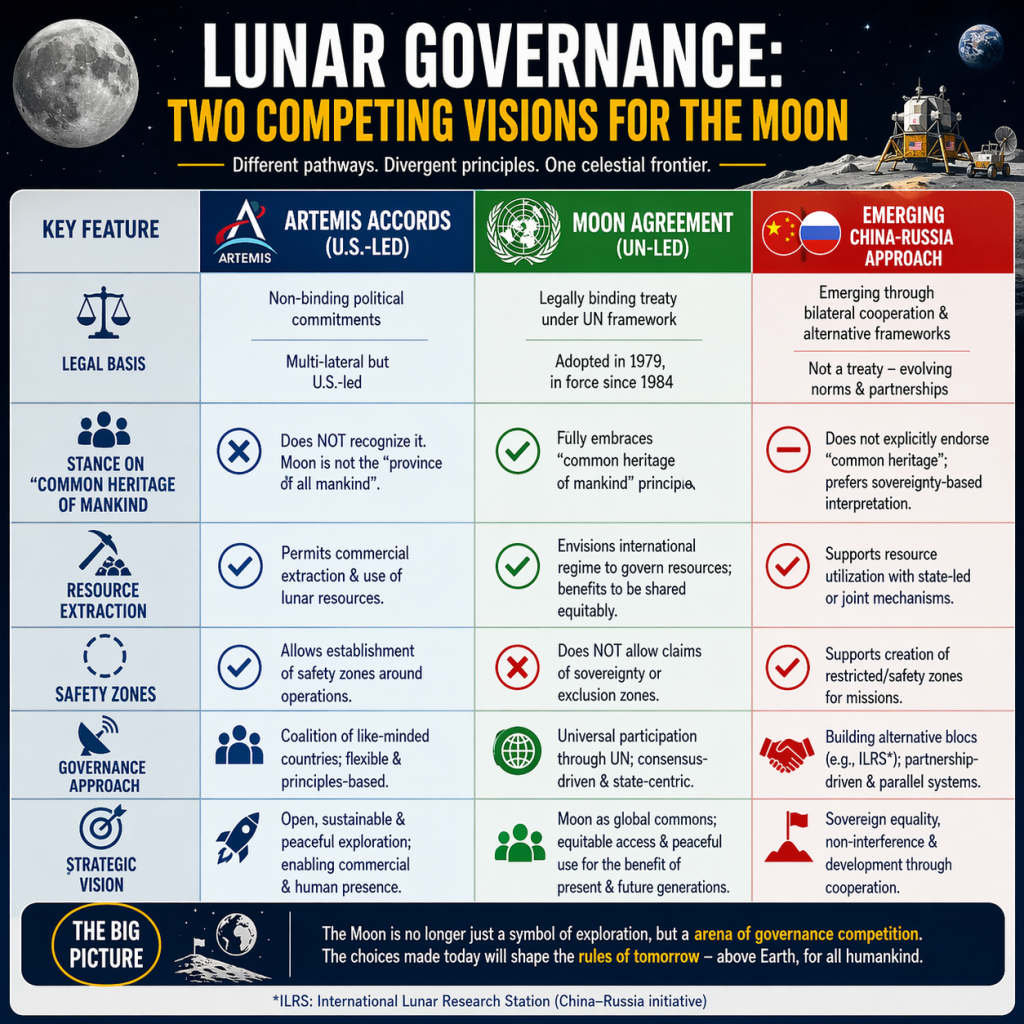
Context: Renewed global interest in lunar exploration (e.g., Artemis missions) has brought focus on governance of lunar resources, even as concerns rise over unilateral actions and weakening respect for international law.
Concerns in Current Space Governance
- Contradiction in leadership credibility: Countries leading space missions have simultaneously been criticised for violations of international humanitarian law and due process.
- Erosion of global legal norms: Actions such as sanctions against international institutions, disregard for ICJ/ICC processes, and WTO paralysis reflect weakening commitment to global rules.
- Unilateral policy orientation: Increasing reliance on self-interest-driven policies raises concerns about fair governance of global commons like outer space.
- This creates a trust deficit in allowing any single power to shape global space governance norms.
Limitations of Existing Frameworks
- A 2015 U.S. law allows private entities to possess and sell lunar resources, shaping the Artemis framework.
- Provisions intended to prevent interference may effectively enable control over resource-rich areas.
- The lunar south pole contains limited water ice, increasing the risk of early-mover advantage and monopolisation.
- The Accords prioritise bilateral agreements over UN-based consensus mechanisms, especially sidelining UNCOPUOS processes.
- Thus, the current model risks creating a first-come-first-served regime in outer space.
Core Issue: Unilateralism vs Global Commons
- Outer space as a shared heritage: Space, including the Moon, is meant to be a global commons benefiting all humankind.
- Geopolitical competition in space: Emerging rivalry between major powers risks turning space into a domain of strategic contestation rather than cooperation.
- Exclusionary governance risks: Frameworks that exclude key players (e.g., China) may lead to fragmented and conflict-prone governance systems.
- Institutional vacuum: Lack of a robust global regime allows powerful nations to shape norms unilaterally.
Way Forward
- Strengthen UN-led processes: Reinforce the role of UNCOPUOS in developing consensus-based space governance frameworks.
- Treaty-based regulation of resources: Develop international rules, potentially drawing from the 1979 Moon Agreement, to govern resource utilisation.
- Ensure equitable participation: Create mechanisms that allow all nations, including developing countries, to have a stake in lunar resources.
- Prevent exclusionary practices: Avoid mechanisms that may indirectly lead to territorial control through safety zones.
- Balance innovation and regulation: While private investment is important, it must be aligned with global norms and collective interests.
Conclusion
- The future of lunar exploration must be guided by multilateralism, equity, and respect for international law, rather than unilateral dominance. A balanced framework is essential to ensure that outer space remains a shared domain of humanity, not a theatre of geopolitical competition.
