

Context
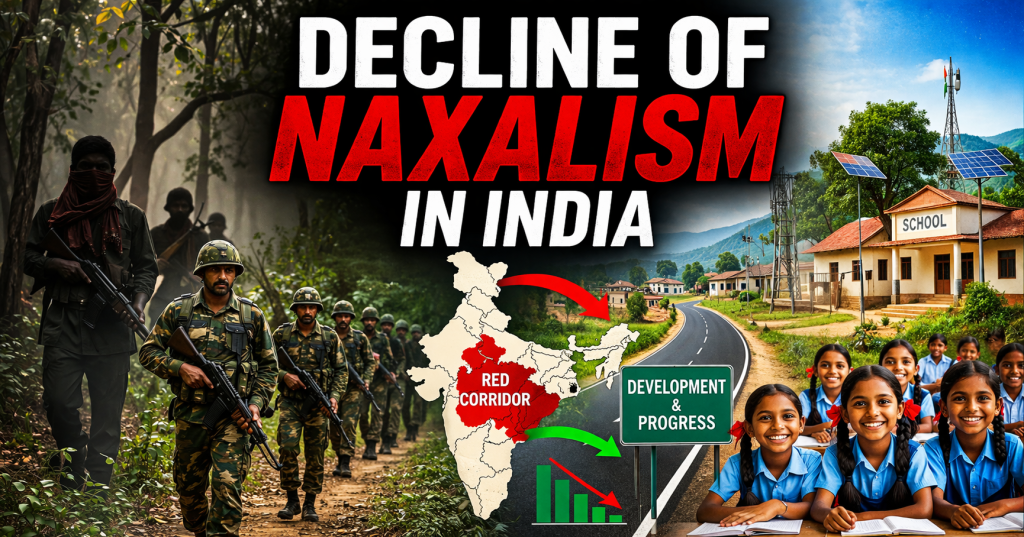
- The Union Government has declared India as “Naxal-free” (2026), marking a major milestone in internal security. Historically, Left Wing Extremism (LWE) was described as India’s biggest internal security challenge, affecting over 180 districts.
Current Status
- The LWE footprint has sharply reduced from 126 districts (2014) to about 7 districts (2026).
- Only 3 districts (Bijapur, Sukma, Narayanpur in Chhattisgarh) remain in the “most affected” category.
- Around 31 districts are now classified as “Legacy and Thrust areas”, requiring sustained governance efforts.
- Violence has declined by 88% (1,936 incidents in 2010 → 234 in 2025).
- Fatalities have reduced by 90% (1,005 deaths in 2010 → 100 in 2025).
- Security operations led to 4,839 surrenders, 2,218 arrests, and 706 neutralisations in recent years.
Factors Behind the Decline of Naxalism
- Security and Tactical Dominance
- Deployment of specialised forces such as COBRA and Greyhounds ensured operational superiority.
- Establishment of Company Operating Bases (COBs) helped penetrate previously inaccessible Maoist strongholds.
- A Unified Command structure improved coordination across States, limiting insurgents’ mobility.
- Financial crackdown by agencies like NIA and ED disrupted funding networks and “urban nexus”.
- Infrastructure and Connectivity Push
- Construction of over 12,000 km of roads reduced geographical isolation of tribal regions.
- Expansion of digital infrastructure with 9,000+ mobile towers (4G) weakened Maoist propaganda networks.
- Ongoing 4G saturation plan (8,500 additional towers) aims to fully integrate remote areas.
- Development and Governance Interventions
- Establishment of schools, Aadhaar coverage, and ration access improved state presence in remote areas.
- Eklavya Schools and Aspirational District Programme replaced Maoist parallel governance structures.
- Dharti Aaba Janjatiya Gram Utkarsh Abhiyan (DAJGUA) scheme targets 63,000 tribal villages with basic services like housing, water, and electricity.
- PM-JANMAN initiative focuses on 75 PVTGs, ensuring last-mile inclusion.
- Rehabilitation and Human-Centric Approach
- Surrender-cum-Rehabilitation policy incentivised over 10,000 cadres since 2014 to rejoin mainstream society.
- Vocational training and cash support created pathways for dignified reintegration.
- Civic Action Programme (CAP) helped build trust through direct engagement with communities.
- Economic and Skill Integration
- Van Dhan Vikas Kendras (2,200 clusters) promoted value addition in forest produce, improving tribal incomes.
- Establishment of 46 ITIs and 49 Skill Development Centres provided employment opportunities for youth.
Persisting Challenges and Concerns
- Security Challenges
- Residual Maoist groups remain active in Abujhmaad forests, capable of asymmetric attacks.
- Presence of underground urban ideological networks remains difficult to monitor and dismantle.
- Inter-state border areas continue to provide tactical safe havens for insurgents.
- Governance and Development Gaps
- Sustaining administrative presence in remote areas remains a challenge due to logistical constraints.
- Withdrawal of security forces may risk creating a power vacuum.
- Limited development of local industries may push unemployed youth back towards militancy.
- Ethical and Political Concerns
- Excessive militarisation raised concerns regarding civil liberties and human rights violations.
- Branding dissenting voices as “urban Naxals” may weaken democratic discourse.
- Risk of crony capitalist exploitation of mineral-rich tribal areas may deepen alienation.
Way Forward
- Shift focus from security-led approach to inclusive development and reconciliation.
- Ensure protection of tribal rights, land ownership, and forest resources.
- Promote participatory governance, integrating tribal communities into democratic processes.
- Strengthen local economies through value addition, forest-based livelihoods, and employment generation.
- Maintain calibrated security presence while avoiding over-militarisation.
- Enhance coordination between States to eliminate residual safe zones.
- Build long-term trust through education, healthcare, and institutional accountability.
Conclusion
- India’s success in reducing Naxalism reflects a combination of strong security measures and expanding state presence. However, lasting peace depends on addressing the deeper issues of development, dignity, and inclusion, ensuring that tribal communities become equal stakeholders in India’s growth story.
