

Context
- India’s higher education system has expanded significantly, raising concerns about quality and equitable access.
- The number of colleges and universities increased from ~1,600 (1950) to over 69,000 (2022).
- Expansion has been largely driven by private sector participation in recent decades. The college density increased from 29 per lakh youth (2010) to 45 (2021).
- However, regional disparities persist, with several northern and eastern districts having fewer than 18 colleges per lakh youth.
Gains in Access and Enrolment
- Gross Enrolment Ratio (GER) increased from 16% (2011) to 28% (2022).
- India’s GER is now comparable with countries having similar per capita income levels.
- Gender parity has improved, with near equal enrolment of men and women.
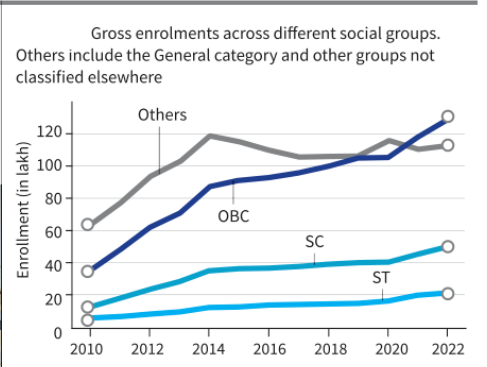
- Participation of disadvantaged groups has increased significantly:
- Scheduled Castes: 11% → 26% (2011–2022)
- Scheduled Tribes: 8% → 21% (2011–2022)
- Reflects progress towards inclusive access, though not yet equitable.
Key Challenges
- Teacher Shortage and Quality Concerns
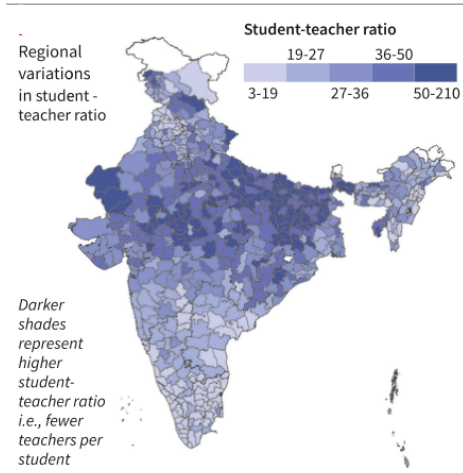
- Recommended student-teacher ratio is 15–25, but actual ratio remains much higher.
- Ratio worsened from 24 (2010) to 35.4 (2016), and stood at 32 (2021).
- Faculty growth has not kept pace with expansion in institutions and enrolment.
- Northern regions with higher youth populations face particularly acute shortages.
- Persistent Inequality in Access
- Graduates remain disproportionately from higher-income households, despite improved enrolment among poorer groups.
- Expansion has not fully translated into equitable outcomes.
- Cost Barriers in Professional Education
- Students from affluent households dominate professional courses like engineering and medicine.
- Annual cost of professional degrees:
- Medicine: ₹97,400
- Engineering: ₹72,600
- For poorer households, these costs often exceed average consumption expenditure, limiting access.
- Low-income students are concentrated in humanities and commerce streams, reflecting structural inequality.
- Regional Disparities
- Uneven distribution of colleges across districts reinforces spatial inequality in access.
- Northern and eastern States lag behind despite high youth population.
Way Forward: Towards Equity and Quality
- Shift policy focus from expansion to quality enhancement and equitable access.
- Increase investment in faculty recruitment, training, and retention.
- Reduce cost barriers through scholarships, fee regulation, and targeted financial support.
- Promote equitable access to professional courses, especially for disadvantaged groups.
- Address regional disparities through balanced institutional distribution and infrastructure development.
- Strengthen public institutions to ensure affordable and quality education.
- Align higher education with employment opportunities, ensuring better socio-economic outcomes.
Conclusion
- India’s higher education expansion marks significant progress, but access without equity and quality limits its transformative potential. A balanced approach focusing on capacity, inclusion, and affordability is essential to ensure that education becomes a true driver of social mobility.
