

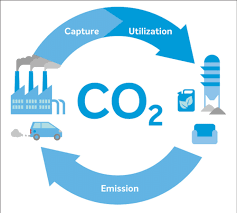
What is CCU?
- Carbon Capture and Utilisation (CCU) captures CO₂ from industrial sources or directly from the air and converts it into useful products such as fuels, chemicals, building materials, or polymers.
- Unlike Carbon Capture and Storage (CCS), which permanently stores CO₂ underground, CCU reuses the captured carbon, putting it back into the economy as a productive input.
Why Does India Need CCU?
- India is consistently the world’s third-largest CO₂ emitter as emissions driven by power generation, cement, steel, and chemicals.
- Many industrial processes are inherently carbon-intensive and difficult to decarbonise through renewable energy alone, called “hard-to-abate” sectors.
- CCU offers a pathway to reduce emissions from these sectors while creating new industrial value chains.
- Aligns with India’s net-zero target for 2070 and its push toward a circular, low-carbon economy.
Initiatives Taken
- Government Initiatives
- Department of Science and Technology has created a specific R&D roadmap for CCU technologies.
- Ministry of Petroleum and Natural Gas presented a draft 2030 roadmap for Carbon Utilisation and Storage (CCUS), identifying projects for implementation.
- Private Sector Efforts
- Ambuja Cements: Indo-Swedish CCU pilot with IIT Bombay to convert captured CO₂ into fuels and materials.
- Organic Recycling Systems Limited (ORSL): leading India’s first pilot-scale Bio-CCU platform, converting CO₂ from biogas streams into bio-alcohols and specialty chemicals.
- Global Practices
- EU: Bioeconomy Strategy and Circular Economy Action Plan explicitly supports CCU as a way to turn CO₂ into feedstocks for chemicals, fuels, and materials.
- USA uses tax credits and funding to scale CCU, particularly for CO₂-derived fuels and chemicals.
Challenges in Scaling CCU in India
- Cost Competitiveness: Capturing, purifying, and converting CO₂ is energy-intensive and expensive; without policy incentives, CCU-derived products cannot compete with cheaper fossil-based alternatives
- Infrastructure Gaps: CCU requires co-located industrial clusters, reliable CO₂ transport, and integration with downstream manufacturing which is unevenly developed across Indian industrial regions
- Absence of Standards and Market Signals: Lack of clear certification, standards, and market demand creates investor uncertainty and limits scaling of CO₂-derived products
Way Forward
- Prioritise Renewables First
- Solar, wind, green hydrogen, and electric mobility must remain primary decarbonisation pathways
- CCUS should be deployed only where emissions are hard to abate i.e. steel, cement, and chemical industries and not as a substitute for clean energy transition
- Pilot and Scale Selectively
- Implement small-scale, high-efficiency CCUS projects to evaluate cost-effectiveness and environmental safety before broad deployment
- Avoid blanket deployment that risks encouraging continued fossil fuel reliance
- Develop a National Storage Atlas
- Storage is as crucial as capture as without safe, accessible storage, CCUS remains ineffective
- ONGC and the Geological Survey of India (GSI) should map depleted oil and gas fields (such as Bombay High) and deep saline aquifers to reduce investment risks and attract private capital
- Technology Transfer and Finance
- India must negotiate with developed countries for CCUS technology transfer and climate finance, positioning it as essential for Global South industrialisation
- Invest in R&D for Direct Air Capture (DAC) and Bioenergy with Carbon Capture and Storage (BECCS) to position India as a leader in climate restoration technologies
