

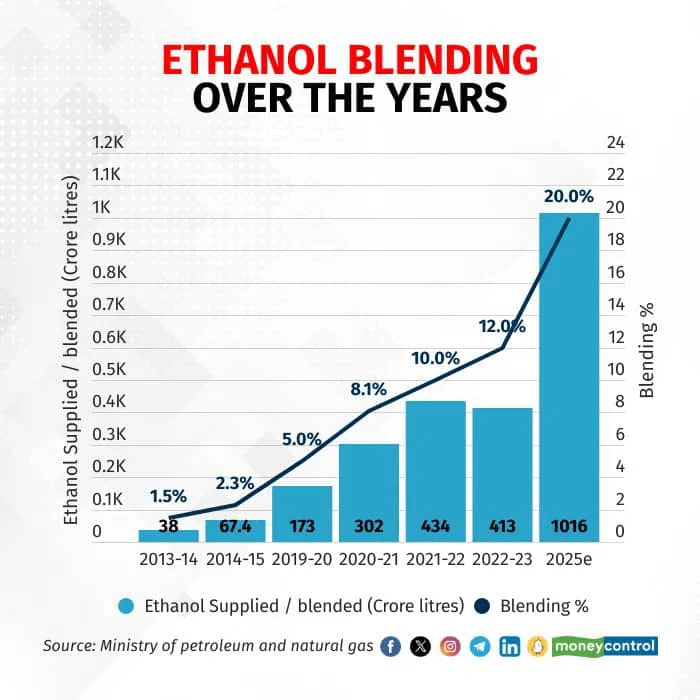
Context: India is exploring 100% ethanol blending (E100) as part of its push towards energy self-reliance and reduced fossil fuel dependence, alongside extending ethanol use to Sustainable Aviation Fuel (SAF).
Understanding Ethanol Blending
- 100% blending (E100) refers to using pure ethanol as fuel, replacing petrol entirely.
- Energy efficiency concern: Ethanol is less energy-dense, with petrol providing 45–55% more energy per litre, leading to lower mileage.
- Engine compatibility challenge:
- Current vehicles are mostly compatible only up to E20.
- Higher blends (E85/E100) require flex-fuel engines with specialised components.
- Cost implications: Flex-fuel vehicles are ₹3–4 lakh costlier, limiting widespread adoption.
- Moving to E100 requires not just fuel transition, but technological transformation of the automobile ecosystem.
Ethanol Production and Resource Concerns
- Primary source: Ethanol is largely produced from sugarcane, a highly water-intensive crop.
- Food vs fuel dilemma: Diverting sugarcane for ethanol risks impacting food prices and availability.
- Second-generation (2G) ethanol: Produced from crop residues (e.g., rice straw), helping reduce stubble burning.
- Cost and sustainability issues:
- Ethanol production remains costlier than petrol, requiring policy support.
- Environmental costs include land use, fertilisers, and water consumption.
Ethanol and Energy Security Linkages
- Reducing import dependence: Ethanol blending lowers reliance on imported crude oil, improving energy security.
- Diversification of energy mix: Complements other strategies like renewables, hydrogen, and alternative fuels.
- CAFE III (2027) aims to reduce emissions by ~30%, indirectly encouraging ethanol use. However, E20 already leads to 6–7% lower fuel efficiency, affecting consumer acceptance.
- Storage, transport, and distribution systems are not fully prepared for higher blending levels.
- Thus, Ethanol contributes to energy security but cannot be a standalone solution.
Ethanol in Aviation: Emerging Possibilities
- Role in Sustainable Aviation Fuel (SAF): Ethanol can be converted into jet fuel via the Alcohol-to-Jet (ATJ) process.
- Technical feasibility: ATJ ethanol is chemically similar to aviation fuel (kerosene). It is approved by ASTM International, allowing up to 50% blending in SAF.
- Advantages: Compatible with existing infrastructure and helps reduce aviation emissions.
- Key limitation: Competing demand for ethanol (road transport + aviation) may strain feedstock availability.
Key Challenges in Achieving E100
- Technological barriers: Limited availability of flex-fuel vehicles and compatible engines.
- Economic concerns: Higher vehicle costs and lower mileage may reduce consumer acceptance.
- Feedstock constraints: Dependence on sugarcane raises concerns of water use and food security.
- Infrastructure gaps: Inadequate systems for storage, transport, and distribution.
- Policy trade-offs: Balancing ethanol use across sectors (transport vs aviation) creates allocation challenges.
- The transition to E100 is constrained by economic, ecological, and technological limitations.
Way Forward
- Promote second-generation ethanol: Shift towards crop residue-based production to ensure sustainability.
- Gradual transition strategy: Move from E20 to higher blends in a phased and calibrated manner.
- Strengthen infrastructure: Develop robust systems for fuel storage, logistics, and distribution.
- Encourage flex-fuel ecosystem: Support manufacturing and affordability of flex-fuel vehicles.
- Diversify energy pathways: Combine ethanol with electric mobility, hydrogen, and renewables.
- A balanced approach is essential to ensure energy security without compromising sustainability.
Conclusion
- Ethanol blending offers a promising pathway towards energy self-reliance and decarbonisation, but achieving 100% blending is neither immediately feasible nor universally optimal. India’s energy future lies in a diversified, multi-source strategy rather than overdependence on a single alternative fuel.
