

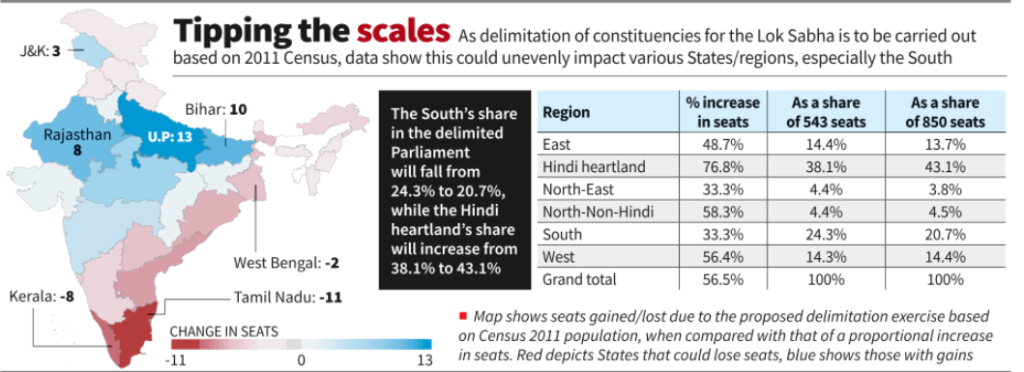
Context: The Constitution (131st Amendment) Bill proposes to expand the Lok Sabha, significantly altering representation dynamics and parliamentary functioning.
Features of the Amendment
- The strength of the Lok Sabha is proposed to increase from 550 to 850 seats, enhancing numerical representation.
- Allocation of seats among States will be based on their population proportion, using a Census specified by Parliament.
- The existing freeze on delimitation until 2026 is removed, with delimitation likely based on the 2011 Census.
- Parliament is given flexibility to decide the timing of delimitation and the Census to be used through a simple majority.
- Reservation of one-third seats for women will be implemented post-delimitation for a period of 15 years.
- A Delimitation Commission will be constituted with provisions similar to the 2002 Commission.
- Provisions are extended to Union Territories with legislatures, ensuring uniform applicability.
Impact of the Amendment
- Redistribution of seats will alter the federal balance, with northern States gaining and southern States losing relative representation.
- The amendment aims to equalise the value of each vote, but may concentrate political influence in populous States.
- Increased Lok Sabha strength without expanding the Rajya Sabha weakens the bicameral balance.
- In joint sittings, Lok Sabha dominance will rise, enabling the government to pass legislation despite Rajya Sabha opposition.
- Expansion will increase the size of the Council of Ministers (up to 15% of Lok Sabha), affecting executive structure.
- Larger House size may reduce individual MPs’ ability to participate effectively, weakening deliberative accountability.
- Potential expansion of State legislatures may create administrative and governance challenges.
Global Precedents
- The U.K. House of Commons has 650 members, supported by frequent sittings and strong committee systems.
- Robust parliamentary committees ensure detailed legislative scrutiny and wider participation.
- In contrast, India refers less than one-fifth of Bills to committees, limiting legislative oversight.
- Effective functioning of large legislatures depends on institutional mechanisms and procedural strength.
Conclusion
- While the amendment seeks to improve representational equity, it raises concerns about federal balance and institutional functioning. A deliberative and consultative approach is essential to ensure that expansion strengthens, rather than weakens, India’s parliamentary democracy.
