

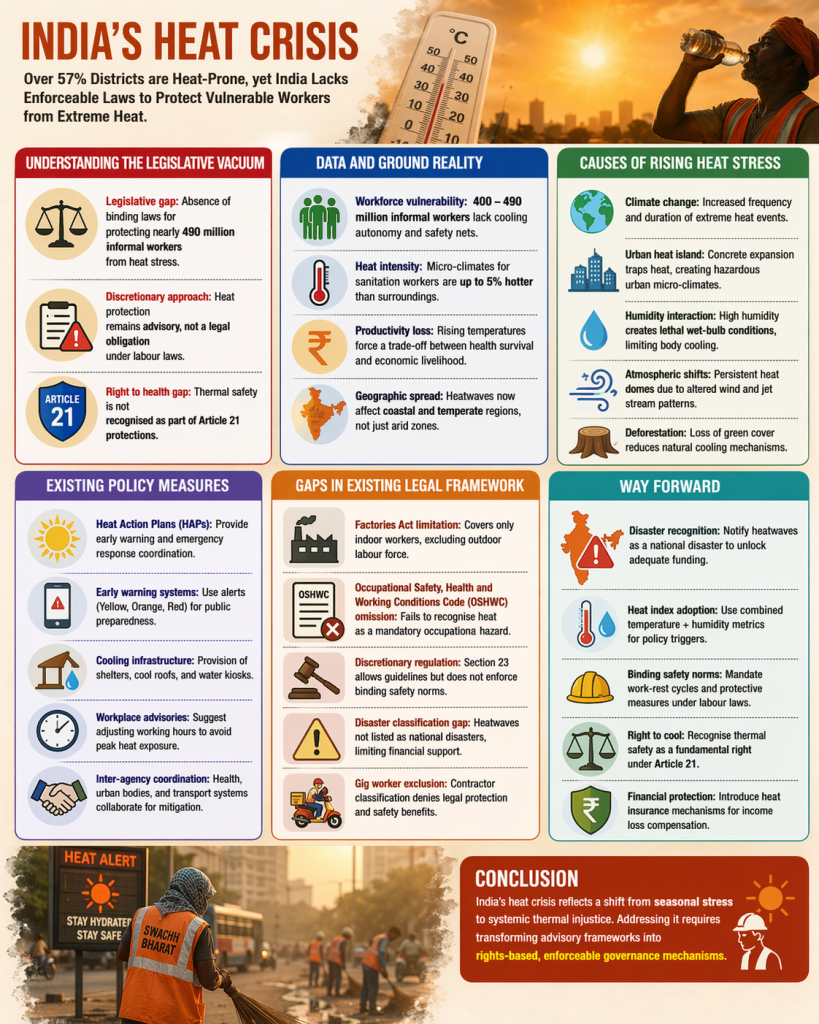
Context: Over 57% districts are heat-prone, yet India lacks enforceable laws to protect vulnerable workers from extreme heat.
Understanding the Legislative Vacuum
- Legislative gap: Absence of binding laws for protecting nearly 490 million informal workers from heat stress.
- Discretionary approach: Heat protection remains advisory, not a legal obligation under labour laws.
- Right to health gap: Thermal safety is not recognised as part of Article 21 protections.
Data and Ground Reality
- Workforce vulnerability: 400–490 million informal workers lack cooling autonomy and safety nets.
- Heat intensity: Micro-climates for sanitation workers are up to 5% hotter than surroundings.
- Productivity loss: Rising temperatures force a trade-off between health survival and economic livelihood.
- Geographic spread: Heatwaves now affect coastal and temperate regions, not just arid zones.
Causes of Rising Heat Stress
- Climate change: Increased frequency and duration of extreme heat events.
- Urban heat island: Concrete expansion traps heat, creating hazardous urban micro-climates.
- Humidity interaction: High humidity creates lethal wet-bulb conditions, limiting body cooling.
- Atmospheric shifts: Persistent heat domes due to altered wind and jet stream patterns.
- Deforestation: Loss of green cover reduces natural cooling mechanisms.
Existing Policy Measures
- Heat Action Plans (HAPs): Provide early warning and emergency response coordination.
- Early warning systems: Use alerts (Yellow, Orange, Red) for public preparedness.
- Cooling infrastructure: Provision of shelters, cool roofs, and water kiosks.
- Workplace advisories: Suggest adjusting working hours to avoid peak heat exposure.
- Inter-agency coordination: Health, urban bodies, and transport systems collaborate for mitigation.
Gaps in Existing Legal Framework
- Factories Act limitation: Covers only indoor workers, excluding outdoor labour force.
- Occupational Safety, Health and Working Conditions Code (OSHWC) omission: Fails to recognise heat as a mandatory occupational hazard.
- Discretionary regulation: Section 23 allows guidelines but does not enforce binding safety norms.
- Disaster classification gap: Heatwaves not listed as national disasters, limiting financial support.
- Gig worker exclusion: Contractor classification denies legal protection and safety benefits.
Way Forward
- Disaster recognition: Notify heatwaves as a national disaster to unlock adequate funding.
- Heat index adoption: Use combined temperature + humidity metrics for policy triggers.
- Binding safety norms: Mandate work-rest cycles and protective measures under labour laws.
- Right to cool: Recognise thermal safety as a fundamental right under Article 21.
- Financial protection: Introduce heat insurance mechanisms for income loss compensation.
Conclusion: India’s heat crisis reflects a shift from seasonal stress to systemic thermal injustice. Addressing it requires transforming advisory frameworks into rights-based, enforceable governance mechanisms.
