

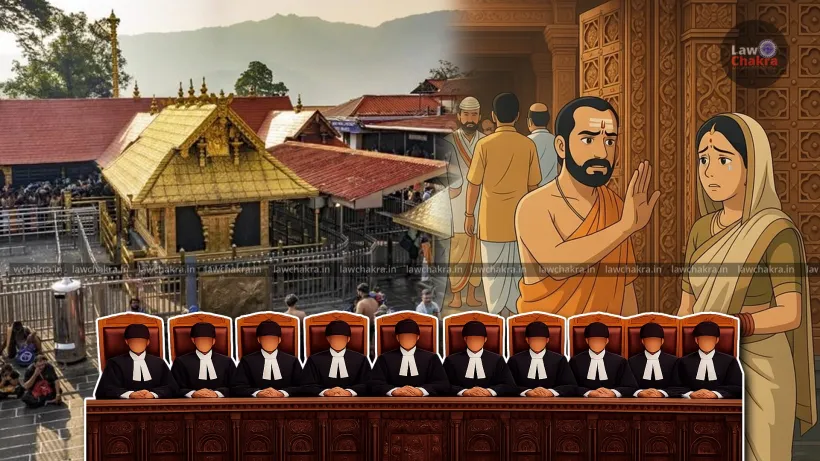
Context: The Supreme Court is revisiting the constitutional validity and broader implications of its 2018 Sabarimala judgment on women’s entry into temples.
Supreme Court’s 2018 Judgment
- The Court struck down the exclusion of women of “menstruating age” as unconstitutional, affirming equality, dignity, and non-discrimination.
- It held that Ayyappa devotees do not form a separate religious denomination, limiting claims under Article 26.
- The practice was not considered an essential religious practice (ERP), and hence not protected under Article 25.
Constitutional Framework: Where the Tension Lies
- Article 25 vs Article 26: Individual freedom of religion must be balanced with denominational autonomy.
- Public order, morality, health: Religious freedom is not absolute and is subject to constitutional limitations.
- Equality provisions: Articles 14 and 15 act as a check against discriminatory religious practices.
- This creates a constant tension between religious autonomy and constitutional morality.
- Role of Essential Religious Practice (ERP) Doctrine
- The ERP doctrine allows courts to distinguish between core religious practices and reformable customs.
- Over time, judicial interpretation has narrowed protection to only those practices that are indispensable to a religion’s identity.
- This marks a shift from earlier rulings that protected a wider range of rituals and observances.
- Role of State and Judiciary in Religious Reform
- State’s reform role: Article 25(2) empowers the State to undertake social welfare and reform measures.
- Judicial intervention: Courts retain the power to strike down practices that violate public morality or fundamental rights.
Key Concerns in the Ongoing Debate
- Judicial overreach: Critics argue that courts may not be best placed to decide what constitutes essential religious practice.
- Subjectivity of constitutional morality: The idea of constitutional morality is seen as interpretatively flexible, raising concerns about consistency.
- Limits of reform: Whether reform should come from courts or through legislative and societal processes remains contested.
- Denominational ambiguity: The definition of a “religious denomination” remains unclear, especially in pluralistic traditions like Hinduism.
- Expansion of Article 17: Applying untouchability provisions to gender-based exclusion raises concerns about constitutional overextension.
Way Forward
- Clarifying ERP doctrine: Develop clearer principles to reduce judicial subjectivity and inconsistency.
- Balanced constitutional approach: Ensure harmony between religious freedom and equality rights without absolute prioritisation.
- Strengthening legislative role: Encourage reforms through democratic processes and social consensus.
- Context-sensitive interpretation: Recognise the diversity of Indian religions while applying uniform constitutional standards.
- Promoting dialogue: Foster engagement between communities, State, and judiciary to ensure inclusive and acceptable reforms.
Conclusion
- The Sabarimala case reflects a deeper constitutional question about how India negotiates faith, rights, and reform. The challenge lies in preserving religious diversity while upholding the core values of equality, dignity, and justice.
