

Context: The potential disruption of the Strait of Hormuz highlights India’s vulnerability to external energy shocks, underscoring the need for diversifying energy sources and reducing import dependence.
Rationale for Energy Diversification
- High import dependence: India relies heavily on external sources for oil and gas, exposing it to geopolitical risks and price volatility.
- Supply chain vulnerability: Narrow chokepoints like Hormuz create risks of sudden supply disruptions and inflationary pressures.
- Climate commitments: Transition towards cleaner energy is essential to meet India’s climate mitigation goals.
- Economic resilience: Diversification reduces exposure to global shocks and enhances long-term energy security.
Path of Diversification
- Pathway I: Expanding Domestic Renewable and Clean Energy
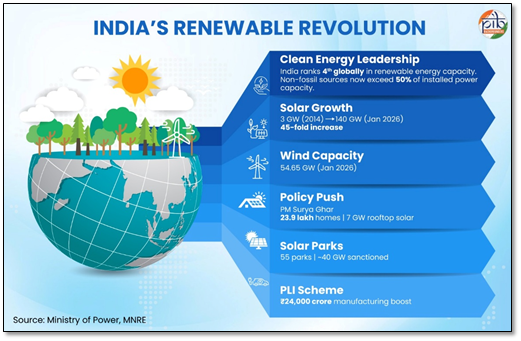
- India aims for 500 GW of non-fossil fuel capacity by 2030, with 1,800 GW solar potential.
- Use of AI and Internet of Things (IoT) can optimise energy systems and enhance efficiency.
- Promoting electric vehicles and electric cooking reduces dependence on fossil fuels.
- Utilisation of agricultural residues, manure, and municipal waste for energy generation.
- Pathway II: Leveraging Biomass and Domestic Resources
- India generates around 950 million tonnes of agricultural residues annually, a significant energy source.
- With about 300 million cattle producing 3,000 million tonnes of manure, biogas production can reach 100 billion cubic metres annually.
- Technologies such as biochar, syngas, and biofuels can convert waste into energy.
- Enhanced domestic resource use can significantly reduce reliance on imported fuels.
- Pathway III: Strengthening Natural Gas Ecosystem
- Natural gas serves as a bridge fuel for transitioning towards a low-carbon economy.
- India imports nearly half of its gas requirements (~35 billion cubic metres).
- Development of pipelines, LNG terminals, and city gas distribution (CGD) networks is essential.
- Enables supply to dispersed industrial clusters, improving accessibility.
Supporting Measures for Effective Diversification
- Domestic rare earth development: Investment in critical minerals is necessary for renewable energy technologies.
- Infrastructure strengthening: Building robust energy storage, transport, and distribution networks.
- Policy and financial support: Incentives such as carbon credits, subsidies, and viability gap funding for new energy sectors.
- Entrepreneurial ecosystem: Encouraging innovation in bioenergy, waste management, and decentralised energy solutions.
Conclusion
- India’s energy future depends on a strategic shift from external dependence to diversified, resilient, and sustainable energy systems. A balanced approach combining renewables, biomass, and natural gas can ensure both energy security and climate responsibility.
