

Context: The spirit of universal adult franchise envisioned by B.R. Ambedkar—linking political equality to socio-economic justice—remains unfulfilled as urban populations increasingly face electoral exclusion.
Nature of the Crisis
- Systematic disenfranchisement: Urban populations, especially the vulnerable, are increasingly being excluded from electoral rolls through procedural and bureaucratic mechanisms.
- Departure from inclusive vision: Earlier understanding (e.g., T.N. Seshan’s view) recognised even minimal residence as sufficient for voting rights, but current practices impose stringent documentation requirements.
- Scale of exclusion: With around 28% of urban population below 18 years and a large share of adults unregistered, effective voter participation is significantly reduced.
- Slum population vulnerability: Nearly 40% of urban population lives in slums (World Bank), where lack of formal documentation leads to exclusion.
Impact of Special Intensive Revision (SIR)
- Large-scale deletions:
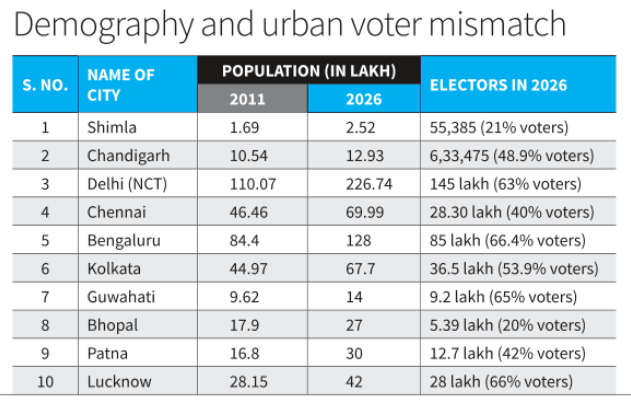
- Migration-related exclusion: High mobility of urban workers makes proof of residence difficult, leading to disproportionate deletions.
- Bureaucratic barriers: Requirement of documents dating back to 2002/2005 creates unrealistic conditions for urban poor.
Social Dimension of Disenfranchisement
- Marginalised groups: Dalits, minorities, migrants, and informal workers face highest rates of deletion and non-registration.
- Dual burden of exclusion: Many are unable to register, while existing voters face removal from electoral rolls.
- Urban poor disadvantage: Lack of formal housing, identity documents, and stable residence makes them structurally invisible to the system.
- Thus the electoral exclusion reinforces existing social and economic inequalities.
Structural Concerns in Electoral Processes
- Rigid emphasis on proof of residence ignores the fluid nature of urban livelihoods.
- Booth-level voting data in small constituencies can reveal community voting patterns, affecting voter autonomy.
- There are concerns that exclusion disproportionately affects groups perceived as politically inconvenient or economically marginal.
- Such practices weaken the principle of “one person, one vote”, undermining democratic legitimacy.
- The issue is not administrative efficiency, but fairness and inclusivity of the electoral process.
Way Forward
- Simplify voter registration: Adopt flexible norms recognising informal residence and migration patterns.
- Ensure proactive inclusion: Shift from deletion-driven processes to maximum outreach and enrolment strategies.
- Strengthen institutional safeguards: Enhance transparency and accountability in electoral roll revisions.
- Protect voting secrecy: Address concerns related to booth-level data disclosure.
- Focus on vulnerable groups: Special measures for migrants, slum dwellers, and informal workers to ensure representation.
Conclusion
- Urban disenfranchisement represents a serious challenge to India’s democratic foundation, as it excludes those most in need of political voice. Thus, ensuring inclusive electoral participation is essential to uphold the principle of substantive democracy and social justice.
