

Context
- The India–New Zealand FTA (2026) marks a decisive moment in India’s trade policy, reflecting a shift towards confident engagement with developed economies in line with the vision of Viksit Bharat @2047.
Trade Architecture
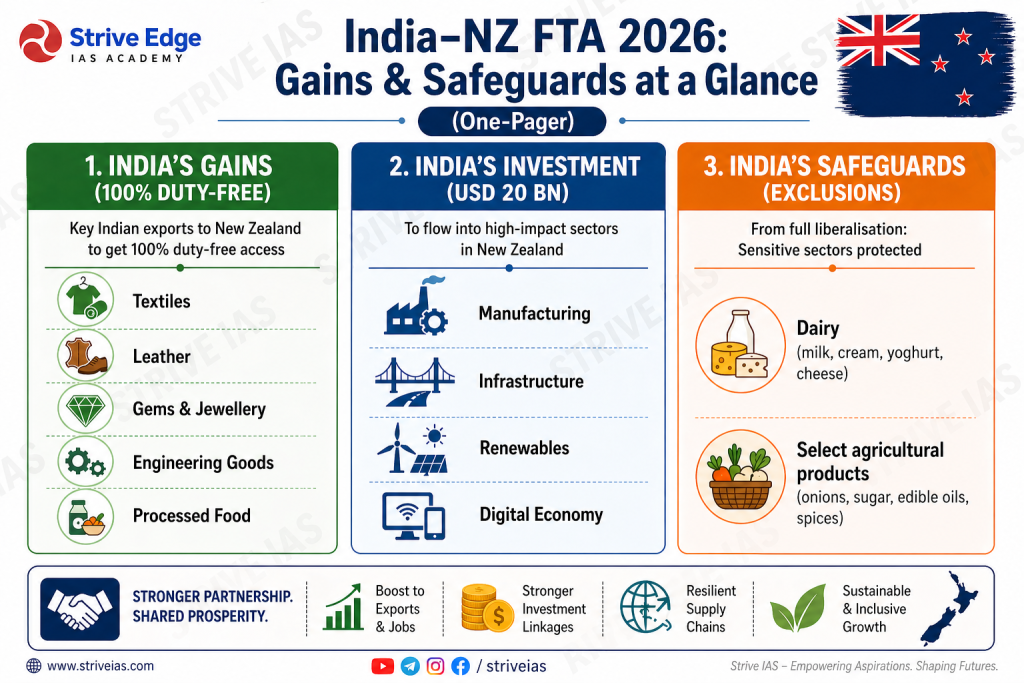
- The agreement provides 100% duty-free access to Indian exports in New Zealand, removing earlier tariff barriers and enhancing export competitiveness.
- Labour-intensive sectors such as textiles, leather, footwear, and gems & jewellery are likely to benefit significantly, supporting employment generation.
- Improved access to inputs like coking coal and metal scrap reduces production costs, strengthening India’s manufacturing ecosystem.
- The overall design promotes India’s deeper integration into global value chains, enabling a shift towards export-led growth.
Protection of Domestic Interests

- India has adopted a measured liberalisation strategy, opening 70.03% of tariff lines (covering 95% of trade value) while excluding sensitive sectors.
- Critical areas such as dairy and agriculture remain protected, safeguarding livelihoods and food security.
- The agreement incorporates phased tariff reductions (3–10 years) and mechanisms like Tariff Rate Quotas (TRQs) to prevent market disruption.
- This approach reflects a careful balance between economic openness and social protection, ensuring that global integration does not come at the cost of domestic stability.
Agriculture, Services, and Human Capital Linkages
- In agriculture, the agreement goes beyond protection to promote productivity enhancement through research collaboration and capacity building, supported by institutional mechanisms like JAPC.
- The services sector gains significant access across 118 sectors, reinforcing India’s strength as a global services provider.
- Provisions for professional mobility (5,000 visas) and enhanced student opportunities create a strong education-skills-employment continuum, strengthening India’s human capital footprint.
- Together, these measures ensure that trade contributes not only to growth but also to long-term capability building.
Investment, Innovation, and Inclusive Growth
- The facilitation of USD 20 billion in investment is expected to accelerate growth in sectors such as infrastructure, renewable energy, and the digital economy.
- Enhanced collaboration in technology, R&D, and skill development supports India’s transition towards an innovation-driven economy.
- The agreement also emphasises the role of MSMEs, startups, and women-led enterprises, ensuring that the benefits of trade are widely distributed across society.
- This reflects a broader commitment to inclusive and sustainable economic development.
Conclusion
- The India–New Zealand FTA exemplifies a mature and strategically balanced approach to global trade, combining export expansion, domestic safeguards, and human-centric growth. By aligning economic openness with social priorities, it offers a template for sustainable, inclusive, and resilient integration into the global economy.
