

Context
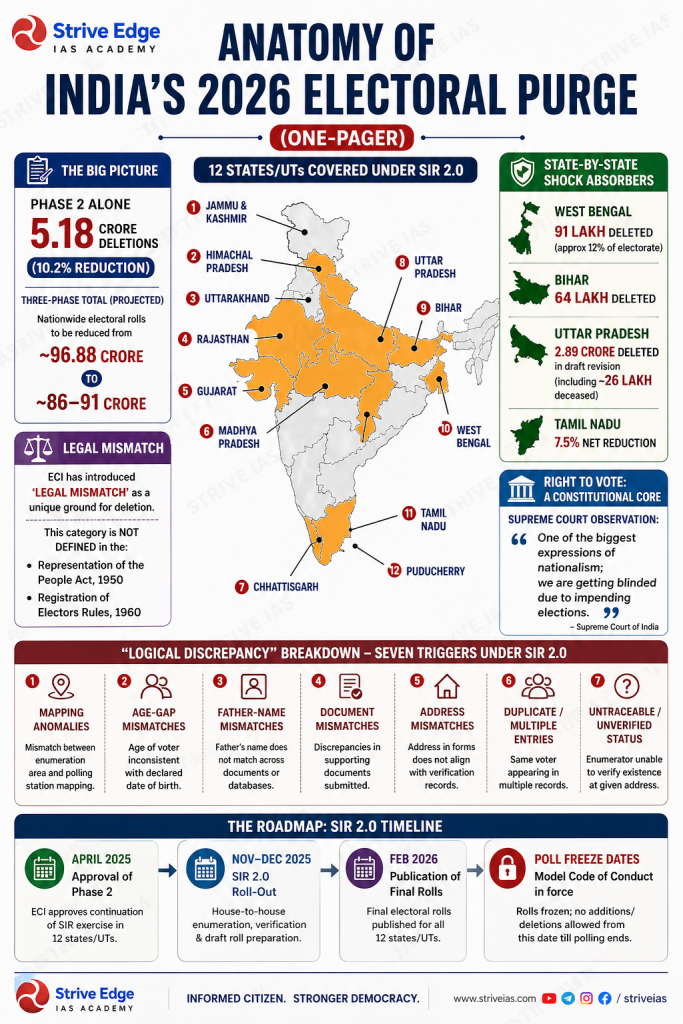
- The recent Special Intensive Revision (SIR) of electoral rolls across several States has led to widespread concerns regarding mass deletion of voters and procedural irregularities.
Nature of Issue
- Reports indicate that lakhs of voters have been removed, including around 91 lakh in West Bengal and 64 lakh in Bihar, often categorised under “logical discrepancy”.
- The term “logical discrepancy” lacks any basis in electoral law, introducing uncertainty and arbitrariness into the process.
- Many genuine citizens were unable to vote, reflecting a shift from inclusive electoral participation to procedural exclusion.
Constitutional Framework
- Article 326 (Universal Adult Franchise): Guarantees that every citizen above 18 years of age, unless disqualified, has the right to be registered as a voter.
- The right to vote is anchored in citizenship, making its determination a matter of constitutional importance.
- Division of Institutional Responsibility:
- Union Home Ministry: Responsible for defining valid documents for proving citizenship.
- Election Commission of India (ECI): Empowered under Article 324 to conduct elections and verify documentation, not to determine citizenship criteria.
- The framework ensures that electoral inclusion remains a constitutional entitlement, not administrative discretion.
Issues and Concerns
- Institutional Concerns
- Jurisdictional Overreach: By prescribing its own list of citizenship documents, the ECI appears to have exceeded its constitutional mandate under Article 324.
- Absence of Clear Guidelines: The lack of an official list from the Home Ministry created a regulatory vacuum, leading to administrative improvisation.
- Judicial Restraint: Limited intervention by the judiciary left core constitutional questions unresolved, particularly regarding institutional roles.
- Legal Deviations in the SIR Process
- Statutory Provisions:
- Section 21, Representation of the People Act, 1950: Allows revision before elections.
- Rule 25, Registration of Electors Rules, 1960: Differentiates between summary (pre-election) and intensive (non-election period) revisions.
- Statutory Provisions:
- Procedural Violation: Conducting an intensive revision close to elections represents a deviation from both law and established practice.
- Arbitrary Categorisation: The use of “logical discrepancy” is unsupported by statutory provisions, undermining legal certainty.
- Administrative and Ground-Level Challenges
- Documentation Burden: Requirement of uncommon or old documents placed disproportionate hardship on rural and marginalised populations.
- Rejection of Common Proofs: Non-acceptance of documents like Aadhaar, ration cards, and voter ID cards created unnecessary barriers.
- Failure of Enumeration Mechanism: Inadequate implementation of house-to-house verification by Booth Level Officers (BLOs) weakened inclusivity.
- Violation of Rule 8 Principle: Information provided by residents “to the best of their ability” was not adequately recognised.
- Violation of Natural Justice
- Absence of Hearing: Many voters were deleted without prior notice or opportunity to respond.
- Denial of Due Process: Such actions violate principles of natural justice and statutory safeguards embedded in electoral law.
- Impact on Fair Elections: Arbitrary exclusion undermines the integrity and legitimacy of electoral outcomes.
- Broader Implications
- Erosion of Universal Franchise: Large-scale deletions weaken the foundational principle of inclusive democracy.
- Democratic Deficit: Exclusion of vulnerable groups leads to distorted representation and governance outcomes.
- Trust Deficit in Institutions: Perceived arbitrariness risks undermining public confidence in electoral bodies.
- Precedent for Future Elections: If unaddressed, such practices may institutionalise systematic disenfranchisement.
Way Forward
- Clarification of Institutional Roles: The Union Home Ministry must clearly define acceptable proof of citizenship, restoring constitutional clarity.
- Strict Legal Compliance: Electoral roll revisions should adhere to statutory provisions and procedural safeguards without deviation.
- Strengthening Due Process: Ensure prior notice, hearing, and appeal mechanisms before voter deletion.
- Inclusive Enumeration Practices: Simplify documentation norms and adopt citizen-friendly verification processes, especially for vulnerable populations.
- Enhanced Judicial Oversight: Courts must actively uphold constitutional morality and institutional accountability.
Conclusion
- The issue of electoral roll purges highlights the delicate balance between administrative efficiency and constitutional guarantees of inclusion. A robust democracy requires that the right to vote is protected not only in principle but also in practice, ensuring that every eligible citizen is able to participate with dignity and confidence.
