

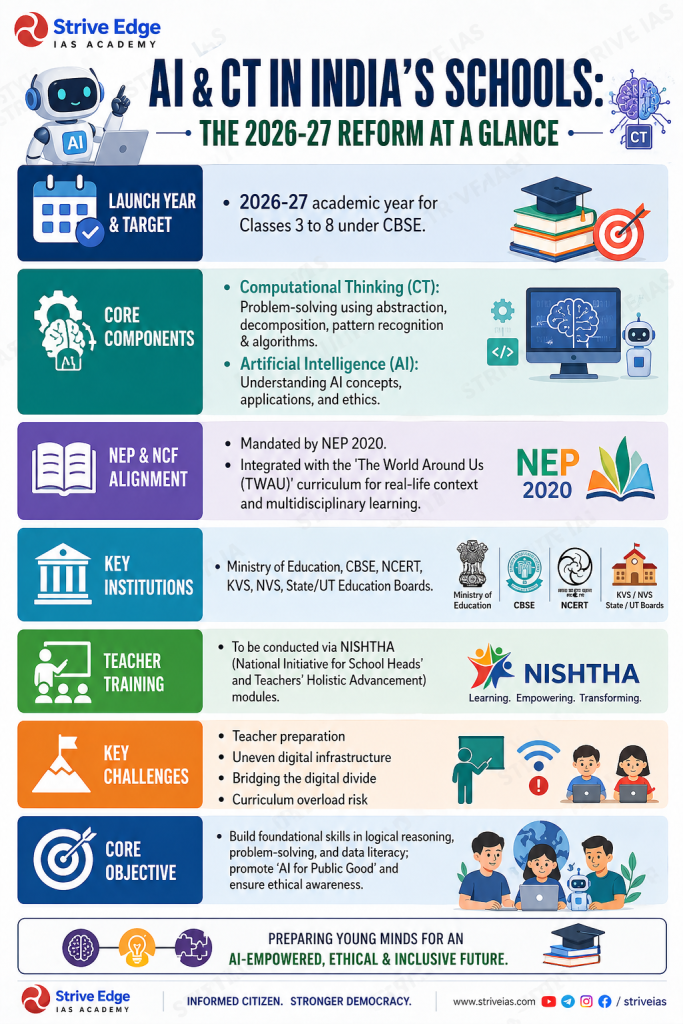
Context: The decision to introduce Computational Thinking (CT) and Artificial Intelligence (AI) in Classes 3–8 from the 2026–27 academic session. This reform aims to prepare students for a world increasingly shaped by data, automation, and intelligent systems, while strengthening foundational cognitive abilities.
Conceptual Foundation of CT and AI
- Computational Thinking refers to a structured way of solving problems through abstraction, decomposition, pattern recognition, and algorithmic logic.
- It acts as a cognitive bridge that enables learners to understand how AI systems function, particularly the distinction between rule-based programming and machine learning.
- The curriculum adopts a progressive learning approach, ensuring that complex ideas are introduced gradually and meaningfully.
- The emphasis is not merely on technology, but on building thinking capacities that underpin digital literacy.
Global Benchmarks and Alignment
- International Alignment: Frameworks developed by OECD, the European Commission, and UNESCO emphasise early introduction of CT as a precursor to AI literacy.
- AI4K12 Model: The U.S.-based initiative structures AI learning across grade bands, placing CT competencies at the foundation of its “Five Big Ideas in AI”.
- Indian Contextualisation: The CBSE framework aligns with these global models while being rooted in NEP 2020 and NCF-SE 2023, ensuring contextual relevance.
- This demonstrates a balance between global best practices and national educational priorities.
Pedagogical Feasibility and Learning Outcomes
- Age Appropriateness: Research indicates that students aged 10–14 years can engage meaningfully with foundational AI concepts when supported by structured pedagogy.
- Empirical Validation: Studies show that learners in the 11–13 age group can grasp ideas such as predictive modelling and basic machine learning.
- No-Code Learning Tools: The use of no-code platforms enables students to design, test, and refine solutions without programming complexity.
- CBSE Design Approach: The curriculum encourages students, especially by Class 8, to solve real-world problems using intuitive tools.
- Pedagogical Transformation
- Inquiry-Based Learning: CT-AI education encourages exploration, experimentation, and reflective thinking instead of memorisation.
- Cross-Disciplinary Integration: Integration with subjects like Mathematics and Environmental Studies promotes holistic understanding and contextual application.
- Cognitive Skill Development: Focus shifts towards problem-solving, reasoning, and analytical thinking, which are essential for lifelong learning.
- Global Evidence: Cross-disciplinary instructional models have demonstrated improvements in students’ reasoning and conceptual clarity.
Ethical and Cognitive Challenges
- Anthropomorphism Risk: Children may attribute human-like intelligence or emotions to AI systems, leading to misconceptions.
- Bias and Fairness: AI systems can reflect data biases, making it essential to cultivate early awareness.
- Digital Responsibility: Safe and ethical engagement with AI tools becomes critical at a young age.
- Curricular Safeguards: The inclusion of modules on AI ethics, fairness, and responsible usage helps address these concerns.
- Ethical grounding ensures that technological exposure is accompanied by critical awareness and responsibility.
Implementation Challenges
- Teacher Preparedness: Effective delivery requires well-trained educators capable of simplifying complex computational ideas.
- Infrastructure Gaps: Access to digital tools, internet connectivity, and learning platforms remains uneven across regions.
- Curriculum Balance: Care must be taken to ensure that new content does not overwhelm learners cognitively.
- Equity Concerns: Bridging the urban–rural divide is essential to ensure inclusive benefits of the reform.
Way Forward
- Teacher Capacity Building: Continuous training programmes must equip teachers with digital pedagogy and computational teaching skills.
- Experiential Learning Focus: Schools should prioritise project-based and hands-on learning methodologies.
- Infrastructure Strengthening: Investment in digital ecosystems and no-code platforms is essential for effective rollout.
- Ethical Literacy Integration: Embedding discussions on bias, fairness, and AI limitations will promote responsible usage.
- Balanced Curriculum Design: Ensuring age-appropriate delivery will help maintain engagement without cognitive overload.
Conclusion
- The introduction of CT and AI at the middle school level represents a forward-looking educational reform aimed at preparing students for a technology-driven future. When implemented with sensitivity and foresight, it can transform education into a process of critical thinking, creativity, and responsible digital engagement, strengthening both individual capability and societal progress.
