


Context: India presents a democratic paradox where high female political participation has not translated into adequate legislative representation, highlighting the need for structural reform.
Impact of Women’s Reservation
- Reservation strengthens representative democracy by expanding the social base of political participation.
- Women leaders bring focus to health, education, sanitation, and welfare issues, improving policy outcomes.
- It challenges entrenched systems of patriarchy and political gatekeeping.
- Representation creates a demonstration effect, encouraging future generations of women leaders.
- It enhances policy responsiveness and inclusiveness, strengthening democratic legitimacy.
Barriers Faced in Women’s Representation
- Party gatekeeping: Political parties nominate fewer women, restricting entry into electoral politics.
- Resource constraints: Limited access to finance, networks, and social capital affects electoral competitiveness.
- Socio-cultural norms: Gender roles and safety concerns discourage active participation.
- Cycle of exclusion: Low representation reduces visibility, perpetuating future underrepresentation.
Other Associated Challenges
- Merit vs reservation debate: Critics question quotas, overlooking structural inequalities in access to power.
- Tokenism risk: Without systemic reform, representation may remain symbolic rather than substantive.
- Implementation delays: Linking reservation with delimitation may postpone actual benefits.
- Institutional inertia: Political systems may resist change due to entrenched interests.
Way Forward
- Ensure timely implementation of reservation to convert political participation into representation.
- Encourage political parties to adopt internal reforms and inclusive candidate selection.
- Strengthen capacity-building initiatives to support effective leadership and governance skills.
- Address socio-cultural barriers through awareness, safety, and institutional support systems.
- Complement reservation with broader measures for gender equality and empowerment.
Conclusion
- Women’s reservation is essential for transforming India’s democracy from participatory to truly representative. Bridging this gap will lead to a more inclusive, responsive, and equitable governance framework.
Parliamentary Trends in Representation
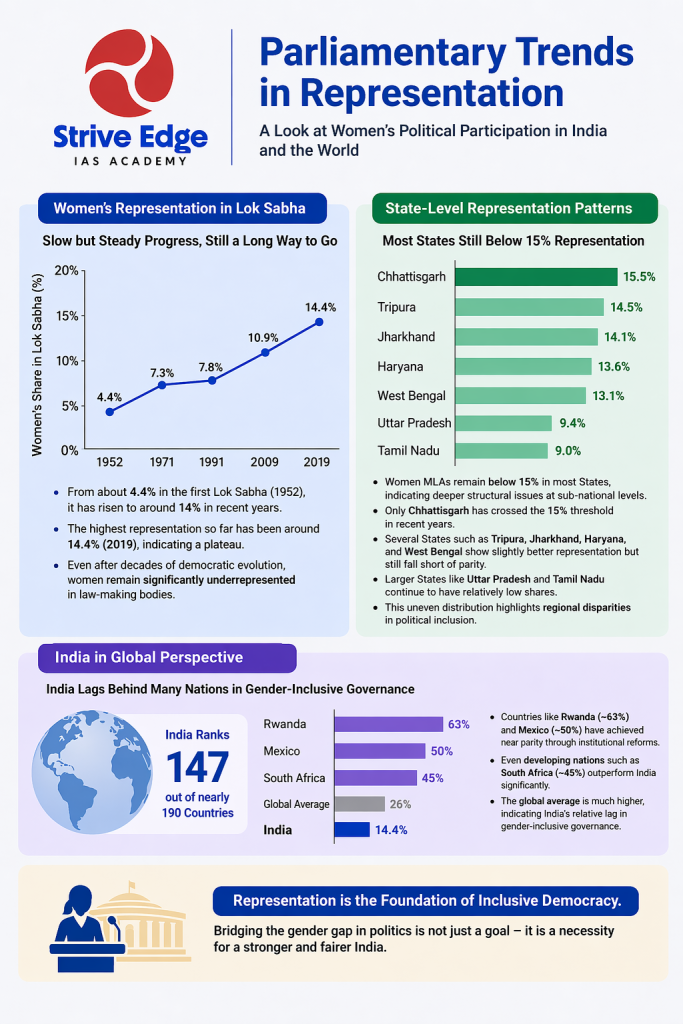
- Women’s representation in Lok Sabha has seen a gradual increase over decades, but remains limited.
- From about 4.4% in the first Lok Sabha (1952), it has risen to around 14% in recent years, reflecting slow progress.
- The highest representation so far has been around 14.4% (2019), indicating a plateau.
- Even after decades of democratic evolution, women remain significantly underrepresented in law-making bodies.
State-Level Representation Patterns
- Women MLAs remain below 15% in most States, indicating deeper structural issues at sub-national levels.
- Only Chhattisgarh has crossed the 15% threshold in recent years.
- Several States such as Tripura, Jharkhand, Haryana, and West Bengal show slightly better representation but still fall short of parity.
- Larger States like Uttar Pradesh and Tamil Nadu continue to have relatively low shares.
- This uneven distribution highlights regional disparities in political inclusion.
India in Global Perspective
- India ranks around 147 out of nearly 190 countries in women’s parliamentary representation.
- Countries like Rwanda (~63%) and Mexico (~50%) have achieved near parity through institutional reforms.
- Even developing nations such as South Africa (~45%) outperform India significantly.
- The global average is much higher, indicating India’s relative lag in gender-inclusive governance.
