


Context: Recent worker protests in industrial regions like Noida highlight gaps between labour reforms and worker welfare outcomes.
Key Issues Behind Worker Protests
- Wage erosion due to inflation: Rising CPI-IW (~25% increase) without timely revision of base wages has reduced real income levels.
- Regional wage disparities: Differences in wage structures across neighbouring regions have created perceived inequality and unrest.
- Weak enforcement of minimum wages: Despite statutory provisions, over 90% informal workforce remains outside effective enforcement.
- Global economic pressures: Supply chain shocks and rising input costs have resulted in delayed payments and job insecurity.
- Exploitation of work-hour flexibility: Ambiguity in Occupational Safety, Health and Working Conditions. Code, 2020 provisions has enabled longer working hours without adequate safeguards.
- Rising job precarity: Expansion of thresholds for layoffs and increased use of fixed-term employment has weakened job security.
- Weak collective bargaining: Fragmented union recognition has reduced negotiation power of workers.
- Gig economy challenges: Platform workers face algorithm-driven wage control and lack of legal recognition, limiting protections.
Structural Concerns in Labour Reforms
- Implementation deficit: Delays in framing state rules have created a legal grey area and uncertainty.
- Dilution of worker protections: Increased thresholds for layoffs reduce job security safeguards.
- Restrictions on strikes: Mandatory notice periods limit collective action and bargaining rights.
- Informal sector exclusion: Majority workforce remains outside effective protection despite formal provisions.
- Gig worker invisibility: Classification as “partners” bypasses traditional labour rights and protections.
Way Forward
- Strengthening wage framework: Make national floor wage binding and ensure regular revision linked to inflation.
- Improving enforcement mechanisms: Shift towards digital monitoring systems to enhance compliance and transparency.
- Protecting gig workers: Adopt models like Rajasthan’s law to ensure welfare coverage and accountability.
- Ensuring algorithmic transparency: Regulate platform economies by mandating disclosure of wage and rating mechanisms.
- Reviving tripartite dialogue: Strengthen cooperation between State, employers, and workers through institutions like Indian Labour Conference (ILC).
- Balancing flexibility and security: Ensure labour reforms do not compromise dignity and livelihood security.
Conclusion
- Labour reforms must move beyond legal consolidation to ensure real protection and dignity for workers. Sustainable growth requires balancing economic efficiency with social justice and labour rights.
Labour Codes in India
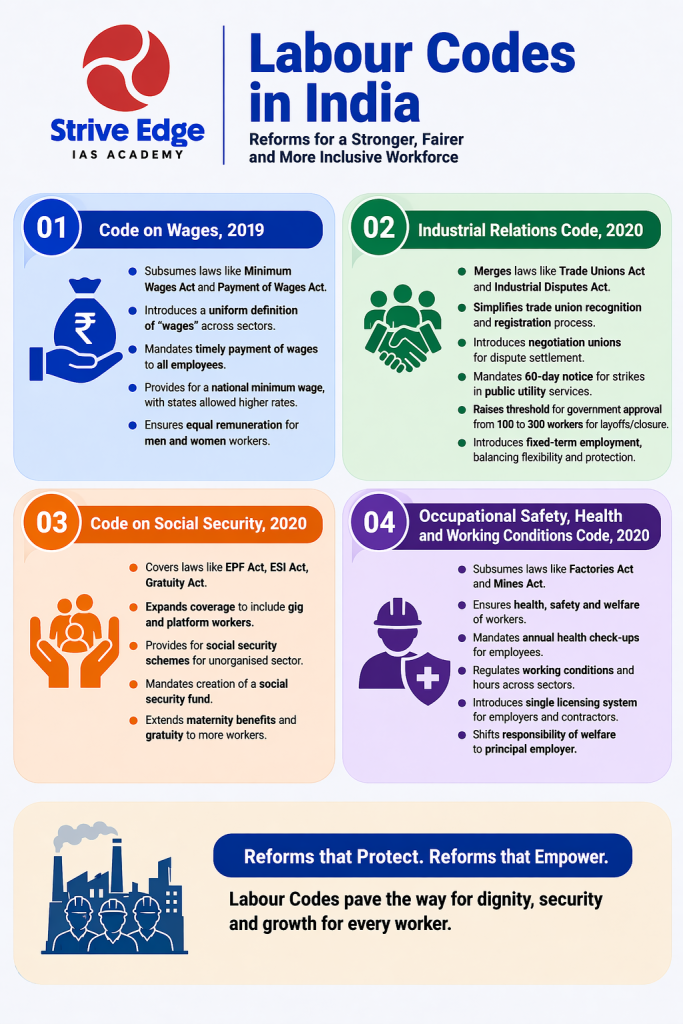
- Code on Wages, 2019
- Subsumes laws like Minimum Wages Act and Payment of Wages Act.
- Introduces a uniform definition of “wages” across sectors.
- Mandates timely payment of wages to all employees.
- Provides for a national minimum wage, with states allowed higher rates.
- Ensures equal remuneration for men and women workers.
- Industrial Relations Code, 2020
- Merges laws like Trade Unions Act and Industrial Disputes Act.
- Simplifies trade union recognition and registration process.
- Introduces negotiation unions for dispute settlement.
- Mandates 60-day notice for strikes in public utility services.
- Raises threshold for government approval from 100 to 300 workers for layoffs/closure.
- Introduces fixed-term employment, balancing flexibility and protection.
- Code on Social Security, 2020
- Covers laws like EPF Act, ESI Act, Gratuity Act.
- Expands coverage to include gig and platform workers.
- Provides for social security schemes for unorganised sector.
- Mandates creation of a social security fund.
- Extends maternity benefits and gratuity to more workers.
- Occupational Safety, Health and Working Conditions Code, 2020
- Subsumes laws like Factories Act and Mines Act.
- Ensures health, safety and welfare of workers.
- Mandates annual health check-ups for employees.
- Regulates working conditions and hours across sectors.
- Introduces single licensing system for employers and contractors.
- Shifts responsibility of welfare to principal employer.
