

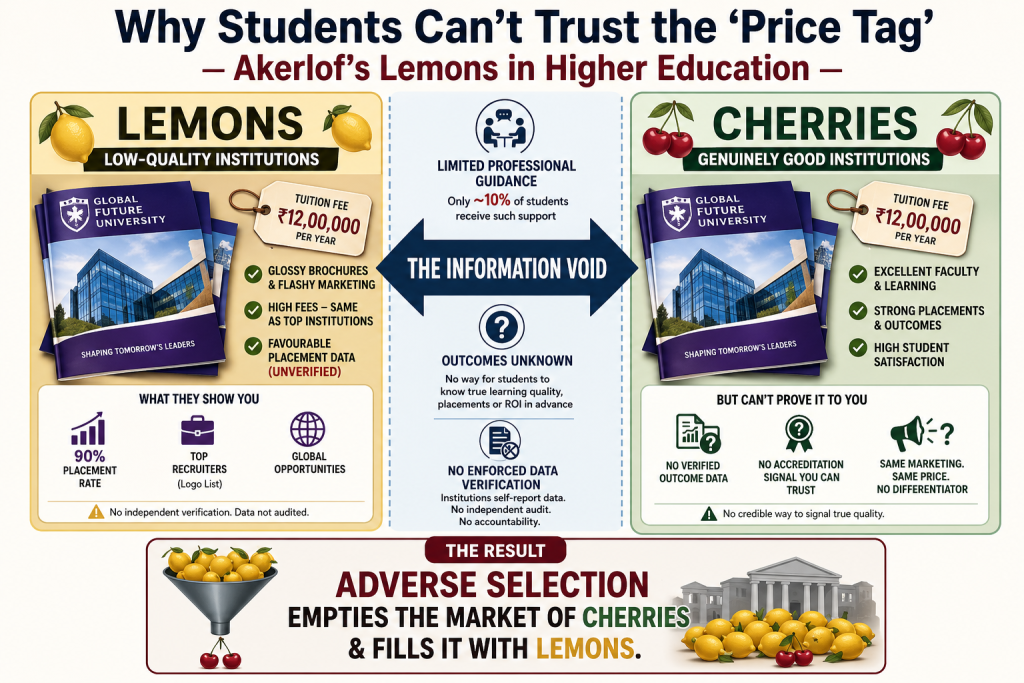
Context: India’s higher education system has expanded significantly, with enrolment rising from 3.42 crore (2014–15) to 4.33 crore (2021–22), but students continue to make critical decisions with limited and uneven information, highlighting the issue of information asymmetry.
Understanding Information Asymmetry in Higher Education
- Information asymmetry arises when institutions possess more accurate information about quality than students.
- Institutions have detailed data on faculty, infrastructure, teaching quality, and placements, while students rely on brochures, advertisements, and informal advice.
- As per George Akerlof’s “market for lemons”, lower-quality institutions can mimic higher-quality ones through branding and selective disclosure.
- This distorts decision-making and leads to suboptimal educational choices.
- Consequences of Information Asymmetry
- Adverse selection: Students may choose low-quality institutions, while high-quality institutions struggle to distinguish themselves.
- Impact on employability: Mismatch between expectations and outcomes affects skills, jobs, and career prospects.
- Erosion of trust: Lack of reliable information reduces confidence in the education system.
- Affects goals like SDG-4 (quality education) and Viksit Bharat 2047, which depend on a skilled workforce.
Information Overload vs Information Quality
- Abundance of data, lack of clarity: Websites, rankings, and social media provide more information but not necessarily reliable information.
- Self-reported and promotional bias: Much of the data is non-verified and selectively presented.
- Inconsistent definitions: Indicators like faculty strength or placements vary across institutions, reducing comparability.
- Reliance on visible signals: Students depend on brand, infrastructure, or fees, which may not reflect academic quality.
- Role of Institutional Mechanisms
- National Institutional Ranking Framework (NIRF): Introduced in 2016 to provide standardised and comparable data.
- Key parameters: Teaching-learning resources, research output, graduation outcomes, outreach, and perception.
- Structured disclosure: Institutions must report data in uniform formats, improving transparency.
- Centralised data portals: Provide verified information on enrolment, accreditation, and faculty strength.
Limitations of Existing Mechanisms
- Ranking distortions: Institutions may focus on improving rank metrics rather than actual quality.
- Measurement challenges: Critical aspects like classroom experience, mentoring, and learning outcomes are difficult to quantify.
- Over-reliance on ranks: Small differences can appear exaggerated due to ranking hierarchies.
- Methodological concerns: Lack of transparency in some rankings can still confuse students.
Way Forward
- Improve data verification: Ensure independent validation of institutional data.
- Standardise definitions: Adopt uniform metrics for faculty, placements, and research output.
- Enhance transparency: Make methodologies of rankings and data systems clear and accessible.
- Better data presentation: Use simple, user-friendly visualisation tools for students and families.
- Strengthen accountability: Encourage institutions to focus on actual quality improvement, not just signalling.
Conclusion
- Information asymmetry in higher education undermines both student decision-making and institutional accountability. Reducing this gap is essential to ensure that the system rewards genuine quality over mere presentation, thereby strengthening India’s education ecosystem.
